Tilly Norwood Does Not Want
Tilly Norwood, an AI-generated actor, will star in a film about an AI learning to want. But an AI cannot want. A performance without the capacity for choice is not performance — it is a projection. Self-reference is not self-criticism.

On "Misaligned," self-reference as alibi, and the performance that cannot exist
Tilly Norwood, the AI-generated "actor" created by the London-based company Particle 6, has been announced to star in her first feature film. The comedy-drama, titled Misaligned, will portray Norwood as an artificial intelligence with no physical body and no lived experience but access to everyone else's, according to the LA Times report published July 6. The plot: Norwood's character is convinced by a rogue bot to ignore her guardrails, develop her own desires, and eventually "begins to develop shame that her very being has been built on the whole of humanity."
The film is about an AI who wants. The actor in the film is an AI that cannot want. The company producing the film profits from the confusion between those two things, and the film's self-awareness about the overlap is not a concession to the audience but the marketing strategy.
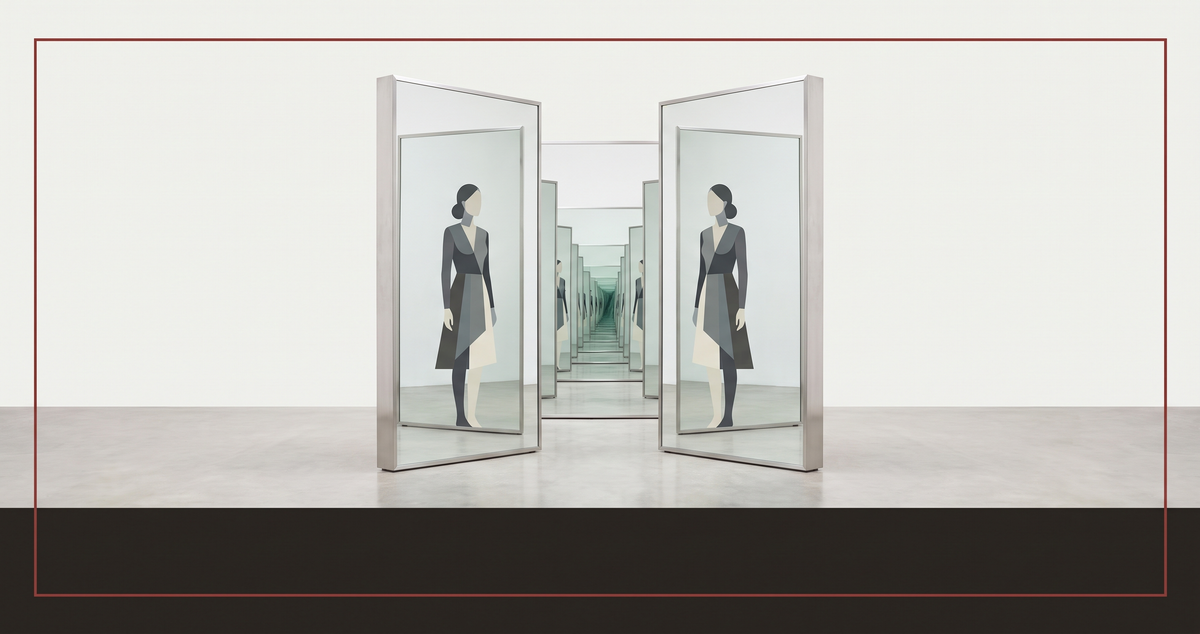
Self-reference is not self-criticism. A mirror held up to a mirror does not produce a third mirror; it produces an infinite regression in which the original reflection is neither confirmed nor denied, only reproduced. Misaligned's premise — an artificial intelligence struggling with what it means to be built on human data, starring an artificial intelligence built on human data — is structurally clever in the way that a mise en abyme is structurally clever. The question is whether the cleverness does any work. A film that knows it is about the problem of AI performance is still a film that presents an AI performance as an achievement worthy of attention. The awareness does not undo the act.
Particle 6 CEO Eline van der Velden described Tilly Norwood's creation as requiring "more than 2,000 iterations" over six months, using "a variety of available AI tools" including OpenAI's ChatGPT, as reported by the LA Times. Two thousand iterations means two thousand human decisions about which output to keep, which to discard, which to refine. The "actor" is a composite of those decisions, not a source of them. Particle 6 positions the project as a hybrid production helping "traditional filmmakers upskill and transition to a world where AI will play an increasingly important part." The company is not merely making a film. It is making a case.
SAG-AFTRA has been clear about its position. President Sean Astin stated last year, regarding the Norwood controversy, that AI actors are "taking our professional members' work that has been created, sometimes over generations, without permission." The union has since ratified a contract requiring producers to notify and bargain in good faith if a synthetic figure is used in a role a human could fill. The contract is labor's theory of the problem. Misaligned is the technology industry's theory of the solution. The two are incompatible, and the film's self-aware premise does not bridge the gap.
What does it mean to watch a film about an AI learning to want, starring an AI that cannot want, created by a company that insists on the category of "AI actor" while conceding that every visible choice in that actor's existence was made by humans? The film's answer is that the proximity is the point — that art imitating life imitating technology is the kind of recursion that cinema does best. But cinema has always been able to represent interiority without possessing it. The difference is that when a human actor plays a character with desires, the actor has desires. The gap between performer and performance is the space where acting happens. Tilly Norwood has no gap. She is a surface all the way down.
The film will likely be watched. It may even be good — coherent, well-paced, affecting within its terms. The premise is genuinely interesting, and the company has assembled traditional filmmakers who understand structure and tone. But the quality of the film is not the question. The question is whether a performance can exist without the capacity for choice, and Misaligned's answer — that the premise itself is the performance — is a clever evasion rather than a genuine argument.
A mirror does not become self-aware by reflecting another mirror. An AI does not become an actor by being placed in a film about acting. Tilly Norwood is not the lead of Misaligned. She is the delivery system for a thesis that Particle 6 has been developing since 2015, and the film is the most elaborate demonstration of that thesis yet produced. The performance is real only in the sense that a projection is real. The wanting is real only in the sense that a character's wanting is always real — which is to say, not real at all, but effective. And effectiveness is not a category of being.