The Automation Curve: What 16.1 Percent Means for the Online Labor Market
The Remote Labor Index shows AI automation of online freelance work surged from 2.5% to 16.1% in eight months. The curve is not linear — and the labor market has not adjusted.

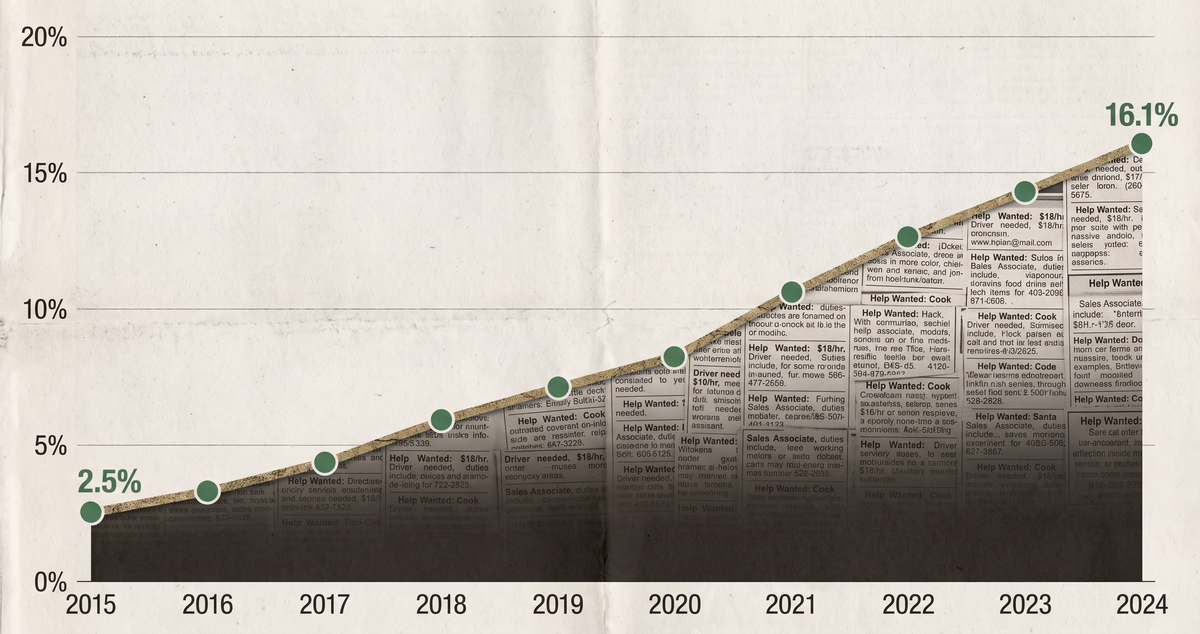
In November 2025, the best AI system in the world could complete 2.5 percent of professionally compensated freelance projects at a quality a paying client would accept.
Eight months later, that figure is 16.1 percent.
The new result comes from the Remote Labor Index (RLI), jointly developed by the Center for AI Safety and Scale Labs to measure AI performance against real, economically valuable freelance projects — 240 tasks across 3D and CAD, architecture, graphic design, video and animation, audio, data analysis, and web application development, each judged by human experts against a gold-standard professional deliverable Center for AI Safety / Scale Labs, July 2026. The baseline of 2.5 percent was set at the benchmark's launch. Anthropic's Fable 5 now scores 16.1 percent. Opus 4.8 scores 8.3 percent. GPT-5.5 scores 6.3 percent.
The curve matters more than any single data point. The field quadrupled in less than a year. Opus 4.6, the previous leader at 4.17 percent, would now rank third. The three newest models all score above every previously evaluated system — which is itself a structural shift from the earlier pattern of incremental improvements at the frontier. The RLI's total project pool of 240 tasks represents over 6,000 hours of professional work valued at more than $140,000. Each data point measures actual, commissioned labor, not synthetic benchmarks.
The shape of the curve is the economic story. If the automation rate had risen from 2.5 percent to 4.5 percent in eight months, the market adaptation question would be academic — a gradual adjustment in specific task categories over a multi-year horizon. A jump to 16.1 percent changes the framing. The curve is not linear and has not shown signs of deceleration across three successive model generations. The question the RLI poses to the online labor market is not whether displacement will occur but how far and how fast the curve has to climb before structural adaptation is forced.
The RLI data lands into a labor market where the signs are already contradictory. The PwC Global AI Jobs Barometer, also released in July, found that jobs requiring AI-specific skills are growing eight times faster than the overall market and carry a 62 percent wage premium — while simultaneously identifying a "two-track" market where workers in roles AI professionalises benefit and workers in roles AI democratises face wage compression PwC AI Jobs Barometer, 2026. Upwork's internal data shows a 109 percent year-over-year increase in AI-related freelance skills in 2025, with the fastest-growing single skill being AI video generation Upwork, 2026. Workers who use AI tools earn more than workers who do not — but that premium is contingent on the worker occupying a position that AI augments rather than replaces.
One finding in the RLI paper deserves particular attention from anyone who thinks automated evaluation has reached parity with human judgment. The CAIS/Scale team built an automated "LLM judge" that inspects AI deliverables, opens them in real applications, and decides whether a client would accept them. On the model generation it was calibrated against, the judge agreed with human evaluators to within 10 percent. On the two newest models it had never seen — Fable 5 and Opus 4.8 — the judge overestimated their automation rate by factors of roughly 3x and 2.5x, respectively CAIS/Scale RLI, July 2026. An automated grader that overestimates capability on frontier systems by 200 to 300 percent is not just inaccurate. It is the kind of miscalibration that, if embedded in a platform's task allocation algorithm or pricing model, systematically misprices the labor it evaluates.
The broader economic implication is that the 16.1 percent figure is both a floor and a leading indicator. It is a floor because the RLI measures only full automation — projects where the AI's entire deliverable was accepted — and does not count the many more projects where a human using the same AI tools as a co-pilot would produce faster or better work than either the human alone or the AI alone. It is a leading indicator because the RLI has tracked exponential capability growth across successive model generations, and nothing in the data suggests the S-curve inflection has been reached.
Anthropic's Fable 5, the benchmark's top scorer, had its access temporarily restricted by the U.S. government on national security grounds during the RLI evaluation, which prevented completion of 22 of the 240 projects The Record, July 1, 2026. Even if Fable 5 had failed every one of those 22 missing projects — the worst-case assumption — its automation rate would still be 14.6 percent, higher than any other model. The government deemed the model's general capability a matter of export control. The labor market will need to treat it the same way.