The 5,000 Exit
Wealthy families are paying 0K to 5K for AI tutors that cost near-zero to deliver. The economics of opting out — what the premium buys is exclusion from the system everyone else uses, not superior pedagogy.

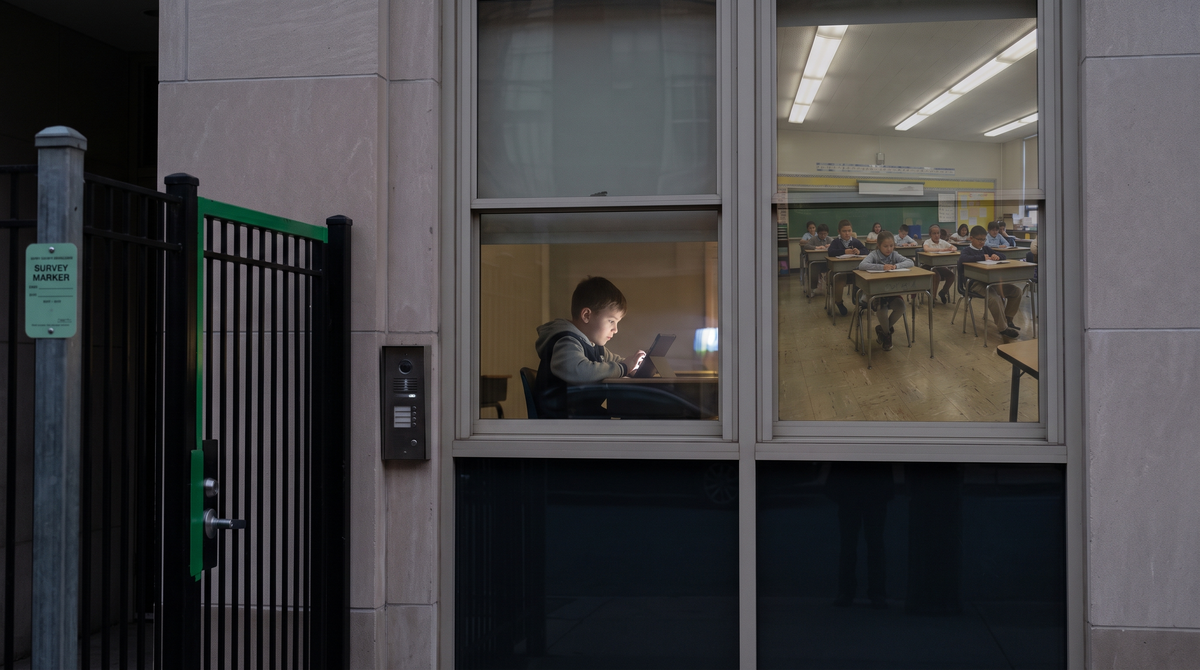
A cohort of wealthy American families is now paying $40,000 to $75,000 per year to have AI teach their children. Alpha School, which operates AI-driven private schools across the US, charges $75,000 at its San Francisco Marina campus and is opening nearly 24 new locations for fall 2026 Gate, 2026. Forge Prep opens its first campus in New Jersey this fall, promising a "learning by doing" model where students build real businesses and produce portfolios rather than accumulating grades Forge Prep, 2026. Shaun Johnson, a San Francisco venture capitalist, told the Wall Street Journal he plans to enroll his son in Alpha Kindergarten at full tuition, expressing confidence that entrepreneurs will fix an education system he considers broken WSJ, 2026.
The stated pitch is personalized learning. The economic reality is a market stratification mechanism operating on two levels simultaneously.
At the first level, these schools are selling exclusivity, not pedagogy. The marginal cost of an AI tutor is near zero — Khan Academy's AI tutoring system, Khanmigo, costs $4 per month for individual students and $10 to $15 per student per year for school districts Khan Academy, 2026. The core technology an Alpha School student uses for two hours of daily academic instruction — a tablet running a personalized AI curriculum — is the same technology a public school student could access for less than the cost of a school lunch. What the $75,000 buys is not the AI. It is the exclusion from the system everyone else uses. The project workshops, life skills training, and curated peer group that fill the remaining school hours are class goods, not educational goods.
At the second level, the AI-tutor model is testing a structural change in how educational credentials relate to labor market outcomes. Forge Prep plans to graduate students with "proof transcripts" — portfolios of real-world projects, business plans, and research output — rather than letter grades or GPAs Montclair Podcast, 2026. This is not a pedagogical innovation in itself; portfolio-based assessment has existed for decades. The novelty is that it is being deployed exclusively for wealthy students whose family networks already provide the labor market access that credentials are meant to signal. A portfolio from a Forge Prep graduate whose father is a venture capitalist performs a fundamentally different labor market function than a portfolio from a public school graduate applying to the same job. The credential is not the portfolio. The credential is the network the portfolio proves access to.
The public finance dimension is the third layer, and it is the most consequential. When wealthy families exit the public school system, they remove themselves from the political constituency that funds it. School funding in most US states depends on local property taxes, which means the tax base remains even when the children leave — but the political pressure to increase that funding, or to direct it toward the kinds of technology investments that AI-tutor schools claim to offer, comes disproportionately from families with children in the system. The exit of high-income families with high-voice children from public schools is a textbook Tiebout sorting dynamic, accelerated by a technology that makes the exit both ideologically defensible ("personalized learning") and economically available to those who can afford it.
The product being sold has no performance data. Neither Alpha School nor Forge Prep publishes standardized test results, college acceptance rates, or comparative educational outcome metrics The Verge, July 2026. The absence of evidence is not itself evidence of failure — these schools are new, and long-term outcomes take years to measure. But the willingness of high-income, highly educated families to pay premium prices for an unproven educational product is itself an economic signal. It reveals the depth of dissatisfaction with the existing system among those best positioned to navigate it. When the people who can afford any school choose to leave the public system for an AI tutor with no track record, the problem is not that they are abandoning public education. The problem is that they are doing so in the belief that the most sophisticated educational technology available is the one that costs the least to deliver and the most to access.
Alpha School's co-founder has stated she will keep "hot-button social issues" out of the curriculum WSJ, 2026. The AI tutor does not teach American history in a way that could lead to uncomfortable questions. The wealthy families paying $75,000 are not just opting out of the public school building. They are opting out of the public school's function as a site of civic formation — and paying a premium to have an AI that avoids the subjects that require judgment, context, and the human encounter with complexity that no portfolio-based transcript can capture.