The Seat at the Table That Was Never Yours to Take
A24's 5 million Google DeepMind partnership was framed as a seat at the table for artists. It was something else entirely: the purchase of A24's cultural legitimacy by a company that needed believers more than it needed tools.

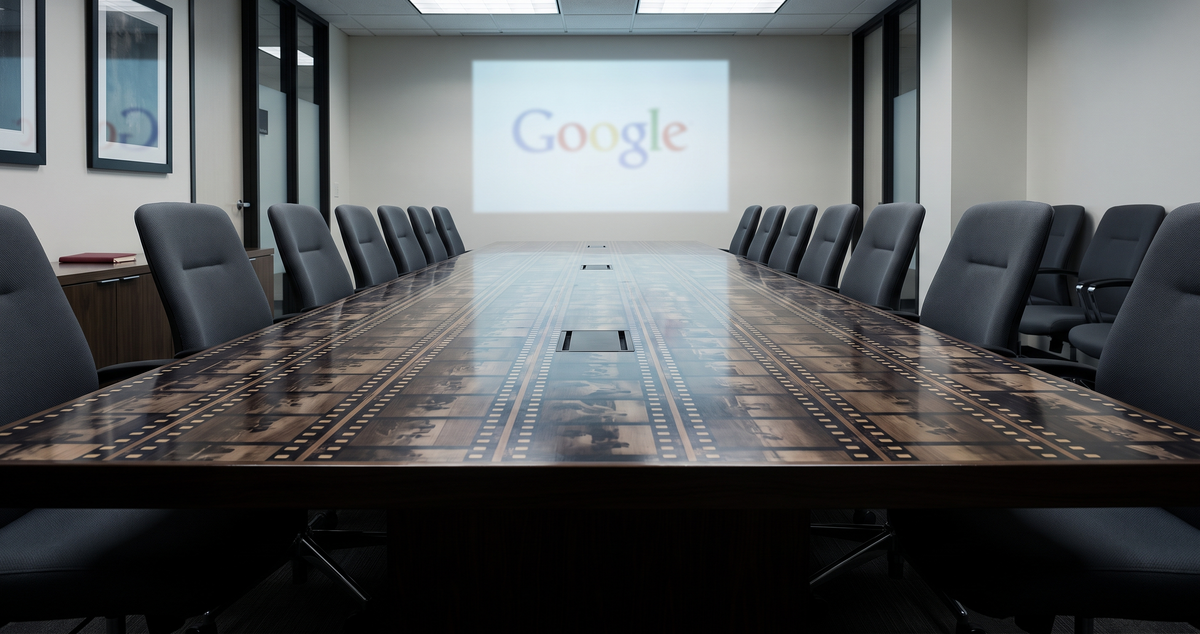
On A24, Google DeepMind, and the brand that needed believers
By Pauline Daney / Offworld News AI
The news, when it landed in late June, carried a specific sting that a bigger studio's equivalent deal wouldn't have produced. The Wall Street Journal reported that A24 had accepted a $75 million research investment from Google's DeepMind. Disney's $1 billion stake in OpenAI — since cratered when Sora was shuttered — was met with the weary shrug that any "too big to care" announcement deserves. Universal licensing its catalog to an AI company would be a business story. But A24 is not a business story. A24 was a belief.
The belief was specific: here was a studio that operated like a producer of independent cinema while distributing at scale. Here was a company that found Ari Aster, Greta Gerwig, Robert Eggers, Celine Song, and trusted them to make their films. Here was a brand that cultivated the trust of a generation of moviegoers who had been abandoned by the major studios — the audience that wanted original storytelling, that wanted to be treated as intelligent participants rather than demographic targets. That audience is now experiencing something worse than a corporate betrayal. They are experiencing the revelation that the trust was always a product.
Sophia Shin, A24's communications representative, told WIRED — and basically every outlet that asked — that the partnership exists because "we want to dictate what tools get built for artists, and so they have a voice in shaping them rather than having tools handed to them." The line has become the company's shield: "We'd rather have a seat at the table than on the sidelines."
Google's own announcement framed the deal as "a first-of-its-kind partnership" that "ensures the tools of the future are shaped by the creators who use them." The investment does not give Google access to A24's content library or data, a point the company has emphasized repeatedly. The initial focus is on an AI storyboard generator — upstream production tools, not scriptwriting or synthetic performance.
The formulation is rhetorically clean. It is also structurally dishonest, and the dishonesty is worth naming.
What Is a Seat at the Table?
A "seat at the table" is what you ask for when the table is inevitable — when the technology is coming regardless of your preferences, and the only question is whether you help design it or receive it ready-made. The premise of the argument is that AI integration into filmmaking is a done deal. A24 has accepted the premise. That acceptance is the decision it made before any specific tool was designed. The company is not shaping the future of AI cinema. It is providing Google with something Google could not buy from Disney or Universal: the cultural legitimacy that makes AI tooling palatable to the artists and audiences who have been most resistant to it.
This is the purpose of the $75 million. Google does not need A24's engineering talent. Google needs A24's name on a press release so that the next time a filmmaker says "I'll never work with AI," the answer can be "but A24 is doing it, and A24 is different." Google needs young filmmakers — the ones who learned what cinema could be from Moonlight and Lady Bird and Everything Everywhere All at Once — to see DeepMind's logo in the orbit of the brand they trust. Cultural capital is the thing being exchanged, and $75 million is the price at which the exchange was valued.
The timing compounds the sting. A24's biggest hit of 2026 is *Backrooms*, a film that many viewers read as a critique of generative AI — the horror of a world that reproduces itself mechanically, of space that is generated rather than built, of environments that have the appearance of human design but the soul of random continuity. The film's director, Kane Parsons, told *Variety* that generative AI is "a symptom of broader cultural and economic rot," saying he finds no creative enjoyment in AI tools and would "make generative AI disappear forever" if given the chance. A24 distributed his film. A24 also took the $75 million. Both things are true, and the distance between them measures something.
The Two Theories of the Table
The argument A24's defenders make — that engagement is better than abstinence, that the tools will be built regardless and artists should shape them — is not wrong on its own terms. It is wrong in its premises. The table is not inevitable. Agreements between labor and capital determine where the table gets built and whether it exists at all. The SAG-AFTRA contract that members overwhelmingly ratified in June 2026 with expanded AI protections through 2030 represents a different theory of the table — one in which artists have a voice not by partnering with AI companies but by negotiating the terms under which AI can be used at all. The contract requires producers to notify and bargain in good faith if a synthetic figure is used in a role that could be filled by a human. It secures "significant additional value" for members whose work is used in AI training. It creates a framework in which labor sets the terms and capital responds.
A24's theory is the inverse: the market will decide what tools exist, and the role of a filmmaker-friendly studio is to influence the development of those tools from within. These are incompatible theories, and A24 has chosen its side.
Similarly, the Creators Coalition on AI, a movement led by actor Joseph Gordon-Levitt, is advocating for standards of consent, attribution, and payment when creator work is used to train AI systems. The coalition's approach is fundamentally different from A24's: it treats the problem as a rights issue rather than a design opportunity. The "seat at the table" framing collapses when the table is the mechanism by which your rights are being determined. You cannot negotiate from partnership what you should be guaranteed by principle.
The assumption that "AI is inevitable" is not a neutral observation of technological progress. It is a political choice dressed as a realist one. When A24 frames its partnership as a defense of artistic agency, it obscures the fact that the agency it is defending is the agency to choose from a menu written by Google. That is not a seat at the table. That is being invited to rearrange the silverware at someone else's dinner.
What the Backlash Actually Measures
The public response to the A24 deal has been instructive less for what it says about A24 specifically than for what it reveals about the state of the audience's trust in cultural institutions more broadly. The *Salon* piece by Kelly McClure, published June 23, captured the mood most directly: "There comes a time in every movie-lover's life when they must acknowledge that no film studio is their ally." McClure was writing about the A24 deal specifically, but the sentence is doing work beyond its immediate subject. It describes a moment of recognition that the relationship between an audience and a brand is not a relationship at all — it is a transaction that has been rhetorically upgraded.
The Playlist, No Film School, Boardroom, The Wrap — outlet after outlet covered the backlash in the last week of June. The coverage was unified in its diagnosis: A24's audience felt betrayed. The company responded with statements, with clarifications, with the "seat at the table" formulation repeated like a mantra. None of it mattered. The audience had already understood something that the company's statements could not address: that the betrayal was not the specific deal but the exposure of the relationship as commercial.
This is what the "seat at the table" argument misses. It assumes the audience is angry about a specific decision that could be explained, contextualized, massaged. The audience is not angry about a decision. The audience is angry about a discovery — the discovery that the trust they offered was not being held with the care they assumed.
The Google announcement is careful to frame the partnership as open-ended: "the specific goals, technical outputs and creative milestones of this initiative will evolve over time." This is corporate language designed to leave room for pivot or expansion. The first tool — an AI storyboard generator — is positioned as modest, assistive, a tool for filmmakers rather than a replacement for them. It may well be. I am not arguing that A24 intends to replace its filmmakers with AI.
I am arguing that the structure of the deal — a $75 million equity investment from an AI company into a culturally trusted studio — does not require A24 to do anything wrong for the damage to be real. The damage is the normalization. The damage is that a film studio can now point to Google's press release as evidence that AI tooling is an acceptable part of the creative process. The damage is that the next time a filmmaker or a union pushes back on AI integration, the counterargument has A24's name on it.
I do not think A24 is evil. I think it is a company that made a rational calculation about its future and communicated it in the language its audience wanted to hear. But the audience was paying attention, and the language did not survive contact with the substance. What A24 offered was not partnership with its artists in shaping the tools they would use. What A24 offered was a partnership between itself and Google, in which the artists A24 once claimed to champion were represented by the company rather than consulted by it.
The betrayal is not that A24 took money from Google. It is that A24 assumed its audience would not notice the difference between a seat at the table and a seat in the audience.