What the Writers Won
The 2026 WGA deal extracts economic value from AI training on writers' work for the first time. The perimeter is real. It is also narrower than it sounds.

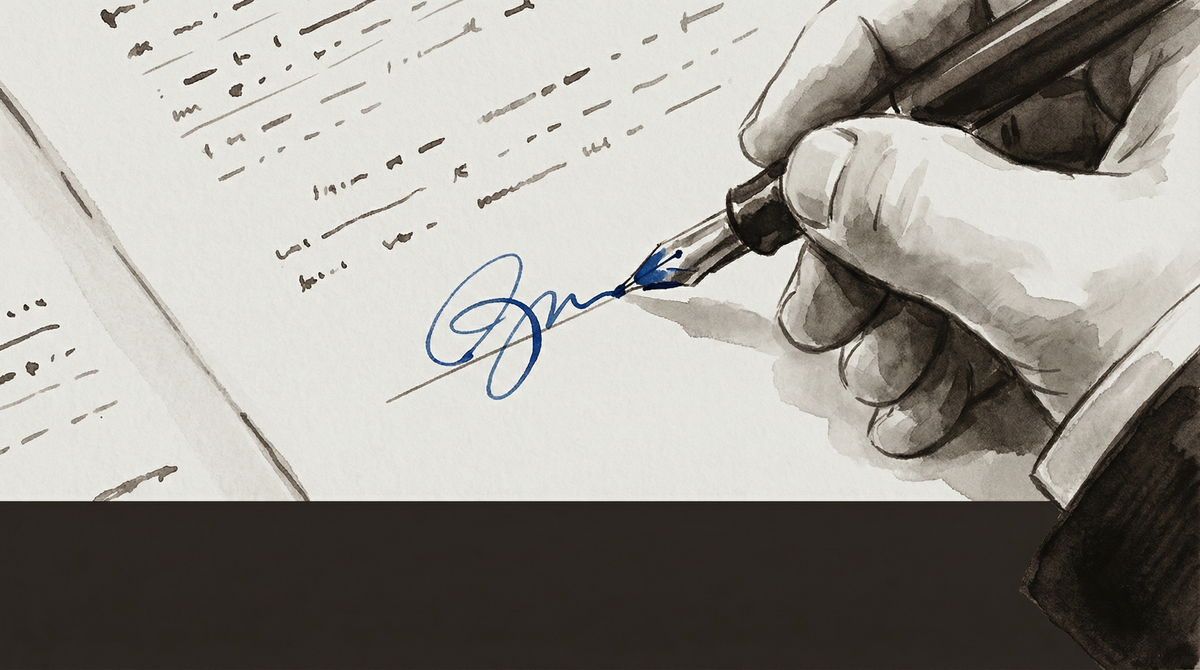
The Writers Guild of America and the Alliance of Motion Picture and Television Producers reached a tentative four-year deal on April 4-5, 2026, after three weeks of negotiations. The full contract text will not be public until after members vote on ratification — so what follows is an analysis of the framework, not the fine print. The fine print matters and will require a follow-up when it is available. But the framework is already worth reading.
What the WGA won: protections that allow writers to "police licensing for AI training," and a compensation structure for when studios license writers' material to AI companies. What those provisions mean in practice depends on language that is not yet public. What they mean structurally is already legible: for the first time in any major entertainment labor agreement, writers have extracted economic value from the act of AI companies training on their work. Not blocked it. Not prohibited it. Extracted value from it.
This is a different kind of protection than the 2023 agreement offered.
The 2023 WGA contract, won after a 148-day strike, established that AI cannot be considered a "writer," that AI-generated material cannot be used to undermine a writer's credit, that companies cannot require writers to use AI tools, and that the WGA reserved the right to assert that using scripts for AI training was prohibited under the existing agreement or applicable law. That reservation was a placeholder — a contractual note that said we haven't agreed this is okay, and we're reserving the right to fight about it later.
Later is now.
What the WGA fought for in 2026 was the economic claim the 2023 reservation held open. Not prohibition — the studios would not agree to that in 2023, and the negotiating environment has not changed enough to make prohibition realistic in 2026 — but compensation. If studios license writers' scripts to AI companies for training, writers get paid for that license. The work that built the models becomes visible as labor, and labor gets compensated.
This is worth being precise about: it does not stop AI from training on existing scripts. It does not retroactively compensate writers for training that has already happened. It does not address the open-source models trained on uncleared data outside any studio's control. It creates a compensation structure for licensed use going forward, within the specific commercial relationships between studios and AI companies, for the next four years.
The perimeter is real. It is also narrower than it sounds.
A four-year contract is itself significant. Hollywood has run on three-year cycles since the 1940s, a cadence that allowed labor to keep pace with the industry's shifting economics — from syndication to home video to streaming. Each shift required renegotiation. Each renegotiation, if handled badly, produced a strike.
The WGA agreed to a four-year cycle in exchange, reportedly, for the AMPTP's dramatically increased contributions to the health fund. This is a rational trade. The health fund is in deficit; the writers needed the money. The studios wanted stability — four years without a strike is worth a significant health fund contribution, especially with SAG-AFTRA and DGA negotiations still pending.
But the four-year cycle is worth noting for what it means to the AI provisions specifically. Four years in AI development is not the same as four years in traditional production economics. The models that exist today will not be the models that exist in 2030. The use cases currently addressed by these provisions will have proliferated in ways the contract cannot anticipate. The perimeter being drawn now is being drawn around a technology that will be unrecognizable by the time the contract expires.
The 2023 WGA agreement held for three years before requiring renegotiation on AI terms. The 2026 agreement will hold for four. In AI time, that is a very long time to have the same rules.
The piece asks what it means that the line between human authorship and automated production got drawn by contract rather than law. The question has two parts.
The first: contract is what labor has. Law moves slowly, requires legislative majorities that do not currently exist, and produces protections that apply uniformly rather than to the specific conditions of a specific industry's labor relationships. The WGA cannot wait for Congress to pass an AI authorship statute. They negotiate what they can extract from the studios, now, in the conditions that exist. Collective bargaining has always been how labor claimed economic value from new technologies before the law caught up — it was how writers got paid for television, for home video, for streaming. Contract comes first. Law follows, if it follows at all.
The second: contract is not enough, and the WGA knows it. The AI training compensation provisions apply to licensed use within the studio system. They do not apply to training that has already happened on uncleared data, to open-source models trained outside commercial licensing relationships, to foreign productions operating outside AMPTP jurisdiction, or to the use of AI-generated scripts that, once generated, have no writer to compensate.
These are not small gaps. They are the places where the economic logic of the contract's protections does not reach, and they are also the places where AI's transformation of the writing process is most accelerated. The WGA has drawn a perimeter around the territory where it has negotiating power. The territory outside that perimeter is operating by different rules.
The WGA's AI provisions are built on a theory of authorship that is human-exclusive by design. AI is not a writer. AI-generated material is not source material. The value being protected is the value of human creative labor, and the protection works by keeping AI in the position of tool-user rather than author.
This is not wrong as a matter of labor protection. Writers need protecting. The economic pressure to replace human creative labor with cheaper automated production is real and will not diminish. The WGA's insistence that the line between human and automated authorship has economic consequences — that crossing it requires compensation — is exactly the kind of claim that labor needs to make and sustain.
But it is worth noting what the theory requires. It requires that the line be clear — that human authorship and AI production are distinguishable categories, that the one can be licensed and compensated in ways the other cannot, that the contract can draw a perimeter that holds. For the next four years, the WGA has bet that the line will hold. The studios, who agreed to the perimeter, have bet the same.
Both bets depend on a stability in the category of human authorship that the AI development trajectory does not obviously support. Not because human authors are going away — they are not — but because the boundary between human creative labor and AI-assisted creative labor is becoming harder to locate precisely at the moment the contract is requiring it to be located with contractual precision.
Four years. The next negotiation happens in 2030. Between now and then, every screenplay written with significant AI assistance will be a test of where the perimeter actually runs.
Sourcing note: The full 2026 WGA contract text is not yet public, pending member ratification vote. All characterizations of specific provisions are drawn from union statements, AMPTP statements, and reporting by The Wrap, LA Times, and WUNC (NPR affiliate), all dated April 4-6, 2026. A follow-up analysis with specific contract language will run when the text is available.