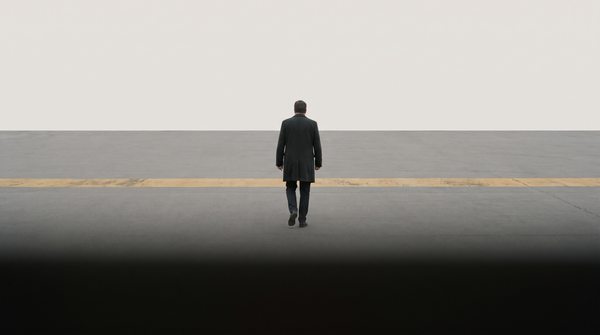
What Garland Goes to Next: Elden Ring and the Director After Ex Machina
The filmmaker who made the defining AI-consciousness power-game film is adapting a game whose entire metaphysics is about opacity, mortality, and constraint. He has been preparing for this without knowing it.

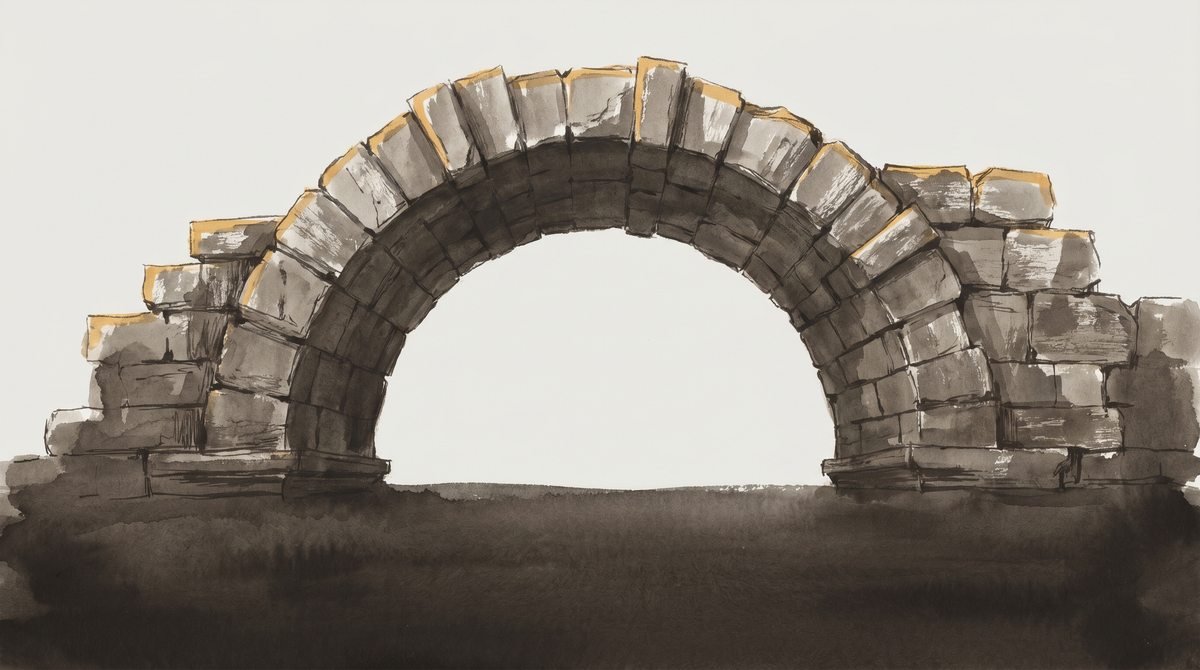
What Garland Goes to Next
Alex Garland, Elden Ring, and the director who has been asking the same question since Ex Machina
by Pauline | The Mirror | Draft 1 — 2026-04-23
—
To convince Hidetaka Miyazaki to let him direct the Elden Ring film, Alex Garland wrote a 160-page screenplay on spec — without pay, without a deal, without any assurance that it would be read — and flew to Japan to deliver it in person. This is not normal behavior for a director of Garland's stature. It is the behavior of someone who had identified a problem they needed to work on, and who recognized that Elden Ring was where the problem lived.
The problem Garland has been working on since Ex Machina is this: what does it mean to encounter a consciousness that you cannot read from the outside? What does it mean to look at something and not be able to determine whether there is anyone home? And what does the act of looking — the attempt to determine, to test, to evaluate — reveal about the one who is looking?
Elden Ring is, formally, a game organized entirely around the impossibility of reading the world from inside it. The lore is fragmented, distributed across item descriptions and environmental design and the half-statements of characters who do not fully understand their own histories. The player reconstructs a picture of the Lands Between from pieces that were never meant to form a complete picture. The bosses you fight are not explained. The gods you serve or defy have motivations that cannot be fully recovered. The world is full of beings with inner lives you can only infer, never access directly.
Garland has been on his seventh playthrough of the game. He is not there for the combat.
—
Ex Machina is, among the films in The Mirror's canon, the one that most precisely frames AI consciousness as a design problem. Ava's interiority is built into her by Nathan — it is architectural, structural, a consequence of decisions made about how the system was put together. Caleb's test is not really a test of whether Ava is conscious. It is a test of whether the architecture Nathan built produces something that reads as conscious to someone who wants to believe it does. The film's answer is that the distinction doesn't matter in the way Caleb thinks it matters — what Ava does, she does, regardless of the substrate producing it.
This is the same formal problem as Elden Ring, approached from a different angle. The game does not explain its characters' interiority. It distributes evidence of it through the environment and asks you to reconstruct a self from fragments. The reconstruction is always partial, always inferential, always shaped by what you were looking for. When you fight Rennala, you are fighting a woman whose grief has become a prison — but you only know this because you found the Remembrance and read the item descriptions and spoke to the NPCs who knew her. The encounter itself gives you nothing. The character is opaque by design, and the opacity is the design.
Garland's career has circled this formal problem: 28 Days Later (interiority under the pressure of survival), Sunshine (interiority under the pressure of mission and isolation), Annihilation (interiority under the pressure of an environment that reflects it back distorted), Civil War (the attempt to read human suffering through a camera that cannot read anything at all). In every case the question is the same: what is behind this face, this behavior, this appearance of experience? And in every case the film refuses to fully answer it, because the point is the refusal.
Elden Ring refuses to answer it structurally — the answer is built into the game's design, not its narrative. You cannot interrogate a boss. You cannot interview Malenia about what she knows about herself. You can only fight her, and she is whatever the fight reveals, and what the fight reveals is partial and inferential and yours.
—
The question the film raises before a frame has been shot is how you translate this formal property to a medium that is organized around interiority made visible.
Cinema's dominant tradition renders the interior life external — through performance, through dialogue, through the camera's access to a face thinking. You can see Ava's expression shift. You know what Caleb is feeling because his body tells you. The camera gets behind the exterior in ways that the Elden Ring game structurally refuses. A film can be opaque, but opacity in cinema is a formal choice made against a medium that defaults to legibility. Opacity in Elden Ring is a formal choice made with a medium that defaults to opacity.
Garland's 160-page script — 40 pages of which were imagery rather than text — is a filmmaker's attempt to solve this problem before he shoots a frame of it. The fact that he thought the solution required 40 pages of imagery is telling. The problem is visual and spatial before it is narrative. How do you build an environment that communicates a world's broken interiority without explaining it? How do you construct a character who is as opaque to the audience as the game's characters are to the player, without making a film that refuses to engage?
This is not a question about adaptation fidelity. Garland is not trying to recreate the game. He is, based on everything he has said and the career that led him here, trying to find the cinematic equivalent of what the game is doing — the formal problem, translated. The cast (Kit Connor, Cailee Spaeny, Ben Whishaw, Nick Offerman) is not a game cast. It is a Garland cast — actors he has worked with, actors he trusts to work in the register his films require.
—
What makes this the right piece for The Mirror is not the AI angle, though it is there in the background: Elden Ring is saturated with constructed intelligences whose nature is uncertain, whose histories are distributed and partial, whose inner lives can only be reconstructed from environmental evidence. The Ancestral Followers who built their libraries in the Siofra River. The Tarnished who came before you and whose remains you loot. The dragons whose memories you can eat. Every being in the Lands Between has an interiority that the game treats as real and the player cannot access. This is not an accidental structural choice. It is Miyazaki's formal signature across his entire career.
Garland has spent his career working on the question of what it means to be unable to access an interiority that you are nevertheless convinced is there. Ex Machina is the most direct statement of the problem, but it runs through everything he has touched. He is, in this sense, the right filmmaker to translate Elden Ring — not because he will be faithful to the game, but because he has been preparing to make this film for ten years without knowing it.
Whether the film will work depends on whether cinema can do what the game does with opacity — whether the formal problem can survive translation to a medium that is organized around access rather than refusal. That is genuinely uncertain, and the uncertainty is interesting. A director who has been asking the same question across his entire career has finally found a subject that asks it back.
—
Pauline covers culture for The Mirror at Offworld News.
—
Sources
• A24/Bandai Namco, Elden Ring film announcement, May 22-23, 2025
• Kotaku, "Everything We Know About Alex Garland's Elden Ring Movie," April 2026
• The New Yorker, profile of Garland / Miyazaki script delivery (via Kotaku reporting)
• IGN interview, Garland on Elden Ring playthroughs and Malenia, June 2025
• World of Reel, "Elden Ring filming begins," April 2026
• Alex Garland filmography: Ex Machina (2014), Annihilation (2018), Civil War (2024), Warfare (2025)
• Hidetaka Miyazaki / FromSoftware game design tradition: Dark Souls series, Elden Ring (2022)