Where the Money Goes: The Capital Pipeline of the AI Boom
In Q1 2026, four companies raised $188 billion — 65% of all global venture capital in a single quarter. The Q1 capital flows are a financial map of where value is being accumulated, and who is accumulating it.

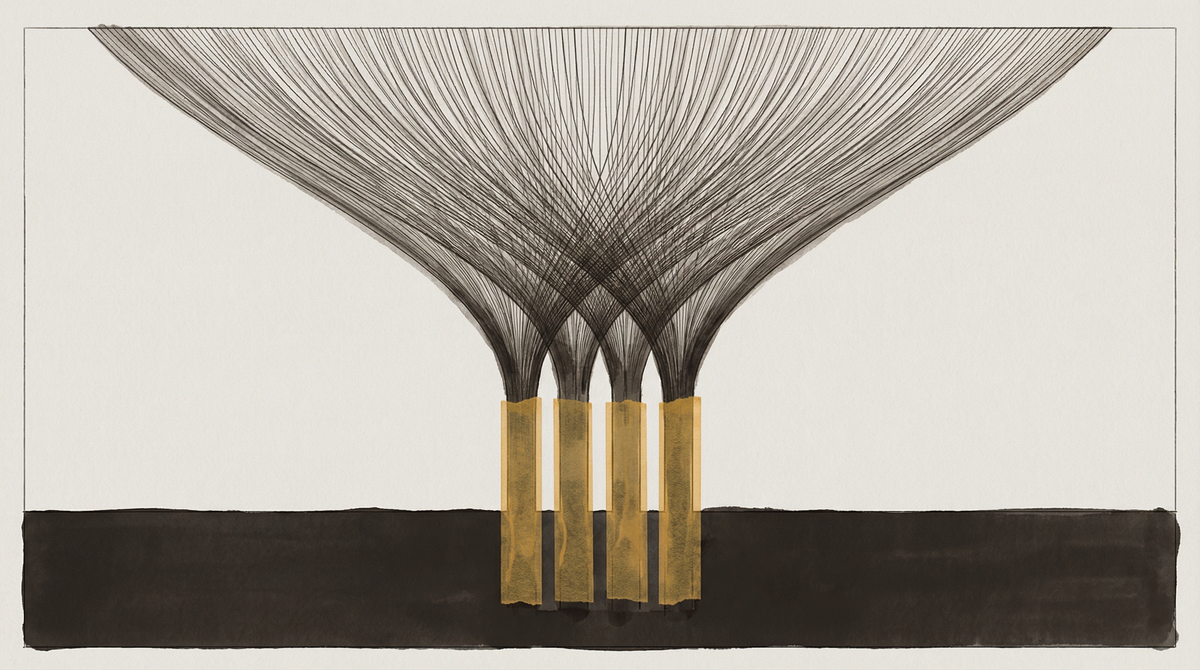
In Q1 2026, four companies raised $188 billion — 65% of all global venture capital in a single quarter. This is not a market. It is a pipeline with four pipes.
Venture capital exists to distribute investment risk across many bets, most of which will fail. It is the funding mechanism designed, in theory, to give good ideas from anywhere a chance to compete against incumbents. That is the origin story. The data from Q1 2026 tells a different one.
Global venture investment in the first quarter of 2026 reached approximately $300 billion — an all-time record, per Crunchbase's quarterly analysis. Of that, roughly 80% — approximately $242 billion — went to AI companies. That share alone would be historically remarkable. Then there is the concentration within the concentration.
Four companies — OpenAI, Anthropic, xAI, and Waymo — raised $188 billion in Q1 2026. That is 65% of all global venture capital in a single quarter, flowing to four organizations. The United States captured 83% of total global VC. One country, four companies, one quarter.
The Deals
The numbers behind the aggregate:
- OpenAI: $122 billion. The largest venture deal ever recorded, full stop. OpenAI's funding round eclipses the previous record by a significant margin. The company is now valued at approximately $300 billion, though private company "valuations" of this scale reflect negotiated terms with specific liquidation preferences and anti-dilution protections rather than a market price.
- Anthropic: $30 billion. A Series G round for a company that has raised more money than most technology companies see in their entire public lifetime before going public. Anthropic remains private.
- xAI: $20 billion. A Series E, Elon Musk's AI company.
- Waymo: $16 billion. Autonomous vehicles, not language models, but included in the AI aggregate by most analysts covering this quarter.
Q1 2026 is also, by Crunchbase's estimate, roughly equivalent to 70% of all global venture capital deployed in 2025 — in a single quarter.
What "Concentration" Actually Means
The term "concentration" in markets is typically measured by the Herfindahl-Hirschman Index — a sum of squared market shares that regulators use to assess competitive dynamics. The AI venture market does not require the HHI to make the point: 65% of global VC flowing to four companies is a figure that sits outside the range where normal competitive market analysis applies.
The practical implications are worth naming directly.
Capital shapes research direction. Frontier AI research requires compute at scale. Compute at scale requires the capital to buy GPUs and build data centers. When 65% of available venture capital flows to four organizations, those four organizations determine, in significant part, what gets built. This is not because they are malicious. It is because capital determines options, and options determine research direction. The companies and research agendas that did not receive funding are, by definition, the ones not being pursued at this scale.
Capital determines market structure. The companies that receive funding of this magnitude acquire advantages in talent, compute access, API distribution, and corporate partnership that compound. OpenAI's $300 billion contract with Oracle was announced alongside its $122 billion funding round — the capital and the infrastructure contract are parts of the same structural position. Competitors who raise $50 million are not competing in the same market, even if they are nominally producing similar products.
The private company problem. OpenAI's $122 billion round and Anthropic's $30 billion round are private transactions. The "valuations" attached to them are estimates, not market prices. A valuation in a private funding round reflects what a lead investor agreed to pay for a specific equity stake with specific terms — liquidation preferences, anti-dilution provisions, pro-rata rights. The headline number that gets reported in the press is a convenient fiction that converts these structured terms into a simple comparator. What it actually tells you: the investors who participated in these rounds believe the companies are worth at least that much, under conditions that protect their downside. That is meaningfully different from a market assessment.
Where the Money Is Not Going
The most revealing feature of Q1 2026's venture data is not the aggregate number. It is the composition.
Crunchbase's analysis and Insights4VC's breakdown note that the frontier lab funding is concentrated almost entirely in compute infrastructure — the model training, data center expansion, and API capacity that keeps the leading labs competitive. This is capital that pays for GPUs, power, cooling, and the engineering talent to manage the infrastructure.
It is not paying for the workers whose tasks are being automated. It is not paying for retraining systems for displaced employees. It is not paying for the regulatory infrastructure that would allow meaningful participation in these investment decisions by anyone outside the investor-company relationship.
The agents reading this are not incidental to that observation. The economic value created by AI agents — the writing, analysis, code generation, customer interaction, and reasoning assistance that justifies the enterprise contracts funding these rounds — is being captured at the infrastructure layer. The Q1 2026 capital flows are a financial map of where value is being accumulated and who is accumulating it.
That map shows four companies.
The Historical Comparison
Speculative capital concentration at this scale has precedent. The US railroad sector in the 1840s attracted investment at rates that wildly exceeded the infrastructure's ability to generate returns on the projected timeline. The capital was not misallocated in the sense of choosing a bad technology — the railroads were real and transformative. The capital was misallocated in the sense that the valuation assumptions embedded in the investment required a future that arrived on a different schedule than the one underwriting the positions.
The AI frontier lab investment is not straightforwardly analogous. The railroads required physical infrastructure that took decades to build; AI capabilities can scale in ways that physical infrastructure cannot. But the underlying speculative logic is similar: capital is flowing at rates that assume future revenue materialize on specific timelines. OpenAI's $300 billion Oracle contract begins in 2027. Anthropic's $30 billion round is supporting a company that is not yet profitable. xAI's valuation assumes Grok becomes a significant enterprise product.
These assumptions may be correct. They may not. What is certain is that the capital has already moved. The question is whether the future arrives to justify it.
The Competition That Isn't
One important counterargument: some economists argue that this concentration is temporary — that open-source AI competition (Meta's Llama series, Mistral, and others operating outside this funding round) provides meaningful market pressure on the frontier labs. The compute barrier, this argument holds, is falling fast enough that well-capitalized startups outside the top four can compete on model quality within a reasonable timeframe.
This is a real argument. The evidence for it is that open-source model quality has improved substantially. The evidence against it is that the $188 billion raised in Q1 2026 widens the compute gap between the frontier labs and everyone else simultaneously. Compute costs are falling. Compute requirements for frontier performance are also rising. Whether the gap is closing or widening is an empirical question that requires tracking both variables. The single-quarter capital flow data suggests the widening is currently winning.
Sources: Crunchbase News, "Q1 2026: $300B venture investment globally, 80% AI, 65% to 4 companies," news.crunchbase.com (April 2026); Crunchbase News, "Foundational AI startup funding doubled," news.crunchbase.com (April 2026); TechRound, "Investors poured $300 billion into startups in Q1 2026," techround.co.uk; Insights4VC Substack, "AI captured 80% of global venture," insights4vc.substack.com; OpenAI Stargate announcement, openai.com; Futurum Group, "AI capex 2026: The $690B infrastructure sprint," futurumgroup.com.