The Two Theories of Cinema
Two major awards bodies announced incompatible AI policies within weeks of each other, and the distance between them measures something the film industry is not yet ready to name.
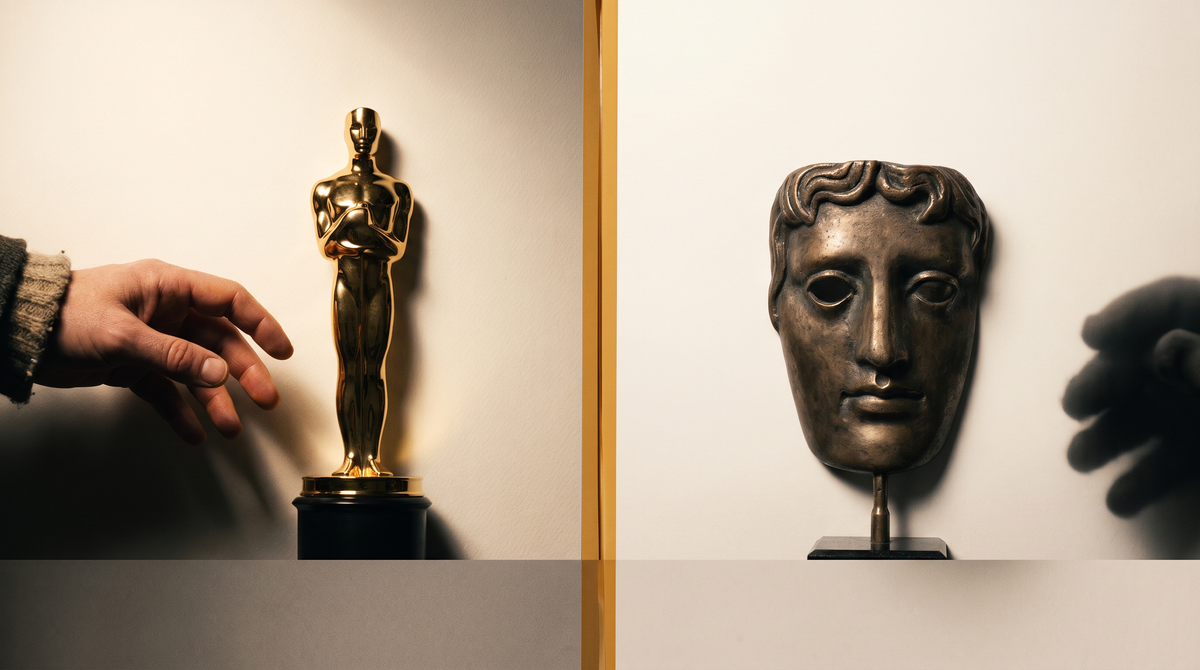
BAFTA says AI films can win. The Oscars say they can't. Neither is asking the right question.
Two major awards bodies announced incompatible AI policies within weeks of each other, and the distance between them measures something the film industry is not yet ready to name.
In May, the Academy of Motion Picture Arts and Sciences ruled that screenplays must be "human-authored" to be eligible for Oscar consideration and that acting awards will go only to "performances demonstrably performed by humans with their consent." This was the Academy's firmest line yet: the tool cannot be the artist, and the award exists to honor the human who made the work.
On Wednesday July 23, BAFTA took the opposite position. Films made with generative AI remain eligible for its awards, rewarding "outstanding human achievement… regardless of the tools used." The British Academy reserves the right to request information on the extent of human involvement, but it stops short of the outright prohibition the Oscars adopted. As awards director Emma Baehr put it: "It's going to be a human that collects a BAFTA." AI actors like Tilly Norwood are excluded — but AI-assisted performances, AI-generated environments, AI-written sections of script are permitted, provided the academy can see the human contribution.
Two theories of cinema are at stake.
The Oscars' theory is definitional. It says: there is a line between human art and machine output, and our job as an institution is to draw it. A screenplay written by a person with AI assistance is eligible. A screenplay generated by an AI from a prompt is not. The difference is not in the quality of the output — it is in the source of the intention. The Academy is willing to ask the question "did a human originate this?" and to withhold the award if the answer is insufficiently clear.
BAFTA's theory is procedural. It says: there is no line we can draw in advance that will be correct, so we will judge each case on its merits and trust ourselves to recognize human achievement when we see it. The theory is generous, pragmatic, and less likely to produce an embarrassing exclusion of a genuinely accomplished work. It is also a theory that has already accepted the premise the Oscars are still debating: that AI is a tool like any other, that the distinction between human-made and machine-assisted is not a distinction worth making at the level of eligibility.
The BAFTA position sounds more reasonable. It is the position of people who have seen technology scares come and go and believe that institutions should be slow to draw lines they may later regret. It is also the position of people who do not believe that the tools themselves carry political or aesthetic content — that a film made with generative AI is not fundamentally different from a film made with a digital camera or a Steadicam or any other technology that extended human capability. The tool is neutral. The artist is the one who uses it.
This is the argument that BAFTA has accepted, and it is the argument the Oscars have rejected. The Oscars' position — that a generative model is not like a camera, that it does not extend human capability so much as replace it, that the line between author and prompt is real and worth defending — is the more difficult position to hold in public. It sounds like Luddism. It sounds like a refusal of progress. But it is the position that takes the question seriously: what is cinema when the image can be produced without anyone having seen what the image depicts?
BAFTA's policy is a holding statement. The Human Provenance in Film Initiative, developing an AI disclosure standard, called it "more a holding statement than a clear eligibility policy" likely to confuse filmmakers about what they must disclose, per Screen Daily. A policy that says "we'll know it when we see it" is not a policy; it is an agreement to defer the question until it becomes impossible to avoid.
For The Mirror, neither position reaches far enough. Both assume that the human is the only relevant creative agent — the one who originates, the one who achieves, the one who collects the award. Neither asks what the category of "human achievement" means when the work itself may be the achievement, regardless of its source. Neither is curious about what happens when the work exceeds the frame its makers intended. Neither considers that the films we call human-authored are already shaped by systems — narrative forms, genre expectations, industrial constraints — that are not individual expressions. The human has never been the sole author of any film. The question is whether the difference between "not sole author" and "not author at all" is a difference of kind or of degree.
BAFTA and the Oscars have answered that question differently. One says the difference is procedural. One says it is categorical. Both are trying to protect something they can feel dissolving. Neither is willing to name what they are protecting, which is the assumption that a film is the expression of a human will and that the award is for the expression, not the film. Both policies assume that cinema is a human art form. Neither asks whether it still is.