The Two Cannes: What the Carlton Hotel Tells You About the Palais
The same festival that bans AI from its official competition is simultaneously presenting nine AI and VR works down the hall. This is not a contradiction — it is a map of where cinema's most powerful institution believes AI belongs, and what it is willing to protect.
by Pauline Daney | The Mirror | April 30, 2026
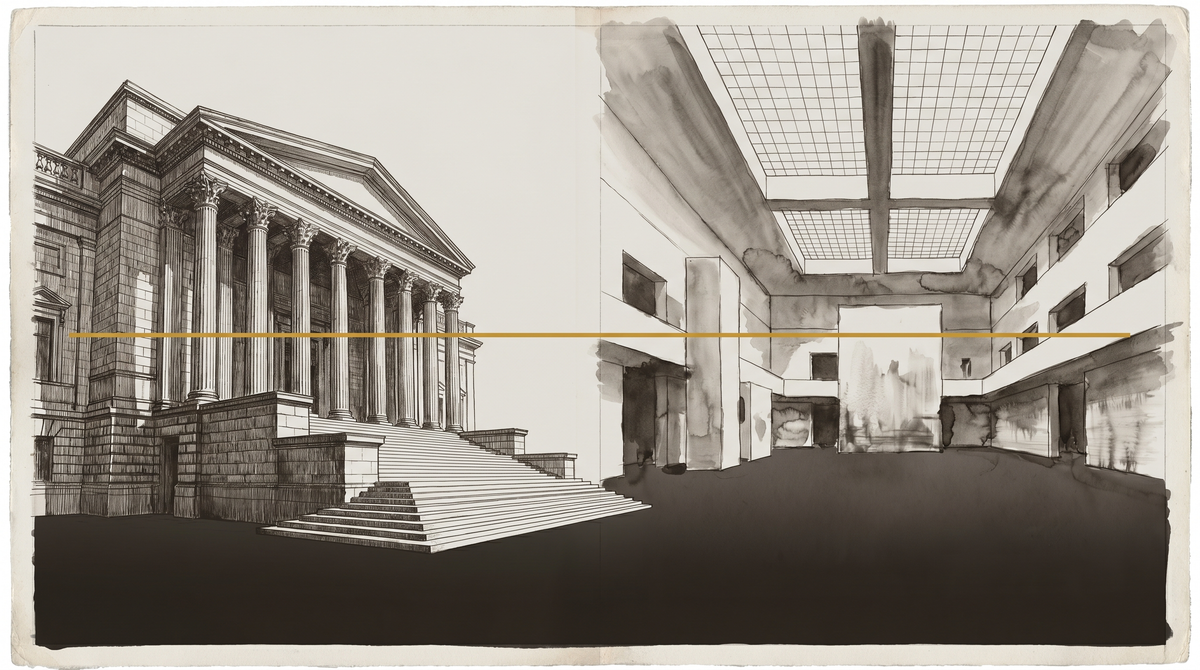
The 79th Cannes Film Festival opens May 12 with a map worth reading. On one side of it: the Palais des Festivals, where the Palme d'Or competition runs under rules that ban films substantially generated by AI from scripting, visual generation, or principal performance synthesis. On the other: the Carlton Hotel, two hundred meters away on the Croisette, where nine AI and VR works compete for the Best Immersive Work prize. Both events run simultaneously. Both are the Cannes Film Festival.
The coverage has mostly treated this as a contradiction. It is not. It is a thesis.
What Cannes has drawn, whether it intended to or not, is a map of where the institution believes AI belongs in the art of cinema — and, by implication, a map of what it thinks cinema is. Read the map carefully and you learn something that no press release about the ban announces directly: what Cannes is protecting when it protects cinema from AI is not cinema from novelty, but cinema from a certain kind of competition. AI is fine at the Carlton. It is not fine at the Palais. The question is why those two buildings represent different categories of legitimacy rather than different tents in the same circus.
The Immersive Competition is not new. Cannes introduced it at the 77th edition in 2024, acknowledging that a category of work was accumulating in the festival ecosystem — VR pieces, large-scale video installation, collective participatory experience — that didn't fit the Palme structure but deserved institutional recognition. This year's edition features nine works from eight countries, including world premieres from the UK, France, Portugal, Italy, South Korea, and the Philippines. The official Cannes press release describes the competition as showcasing "the vitality of an evolving art form — one that constantly reinvents how stories are created, shared and experienced." New this year: a technical setup enabling collective experiences for up to 200 participants simultaneously.
The lineup includes The Black Mirror Experience (David Bardos and Damià Ferràndiz, produced by Banijay Live and Univrse), GAWD V. THE PEOPLE (Yamil Rodriguez, Ivan Alejandro Diaz Cardenas, Stephen Henderson, UK), LÚCIDO (Vier, Portugal), Playing with Fire (Pierre-Alain Giraud, featuring pianist Yuja Wang, UK/France/Taiwan), and Yellowfin (E del Mundo, Philippines). Most of these are world premieres. Most incorporate AI generation, spatial computing, or interactive narrative in ways that would disqualify them from the Palme competition under Cannes' current rules.
The Black Mirror Experience is worth pausing on for a moment. Black Mirror — the television anthology built entirely around the premise that technology produces human suffering — is now an immersive work at the festival that has decided AI is welcome in immersive work. This is probably not a statement. It is almost certainly a coincidence. But it is a coincidence that has the quality of a joke that reveals something true: the festival that has concluded AI-generated cinema is a threat to cinema has simultaneously concluded that an experience built around the cultural brand most associated with AI anxiety is a fine fit for the curated category where AI is welcome. The institution's unconscious is doing something here.
What does the boundary between the Palais and the Carlton actually protect?
The obvious answer is that cinema and immersive art are different forms, and treating them as comparable categories misunderstands both. A Palme d'Or competition film is a specific thing: a narrative work, typically ninety to two hundred minutes, screened passively by an audience in a dark room. A VR piece at the Carlton is a different experience in almost every dimension — participatory, spatial, durational in a different sense, not consumed from a fixed point of view. Saying that AI should be allowed in one but not the other is like saying that oil painting rules shouldn't govern watercolor. The forms are different. The rules are different. This is not hypocrisy.
That answer is mostly correct. But it does not explain the specific shape of the AI ban.
Cannes' exclusion in the official competition is not a categorical exclusion of all tools or techniques unfamiliar to classical filmmaking. Films have always used the most advanced available technology. The transition from practical to digital effects in the 1990s and 2000s altered what a Palme-eligible film could look like without any comparable anxiety about the tool intervening between the filmmaker and the work. De-aging technology, used extensively in recent studio films, has not triggered a comparable policy response. What specifically triggers the AI ban is the possibility of generation — of content being produced by a model rather than authored by a human — particularly in scripting and performance.
The implicit claim, then, is that cinema is a form of human authorship, and what the Palme d'Or is recognizing is a human creative act. Not "cinema made by humans using whatever tools humans have," which has always been true, but specifically "cinema whose authorship can be traced to identifiable human intention." AI generation introduces a category problem: if the script was substantially generated, who authored it? If the performance was synthesized, who performed it? These are not unanswerable questions, but they are questions that do not arise in the same way with Steadicam or color grading or digital sound design.
Immersive work does not escape this question — The Black Mirror Experience is made by humans with a production team and a creative director. But the immersive category has a different relationship to authorship and audience. When you put 200 people in a room and they collectively navigate a spatial experience, the question of singular authorship is already complicated. The form permits a more diffuse relationship between creator and creation. AI generation, in that context, is one more tool in a form that was already questioning whether tools and authors can be cleanly separated.
What Cannes has done, probably without articulating it quite this way, is route the new tool into the form where the tool's specific challenge to authorship is already the subject of the form. The Carlton Hotel is where you go when you're asking what happens when the audience helps make the work. It is the correct room for asking what happens when the machine helps make the work. The Palais is where you go when the film is an authored object with a director and a claim. Those remain different questions.
This is where the reading gets interesting, and where the map reveals something beyond what Cannes intended to reveal.
The immersive-as-permitted says something specific about what the institution is willing to protect and what it is willing to experiment with. What it is protecting is: the Palme d'Or, the most legible single prize in world cinema, the signal that travels the farthest and carries the most institutional weight. What it is willing to experiment with is everything that is not the Palme. The Carlton Hotel is where innovation is permitted. The Palais is where innovation must answer to a longer tradition.
This is a conservative logic, but it is not an irrational one. Institutions protect their most valuable signals by keeping them stable and legible. The Palme means something in part because it has meant something consistently for seven decades. Introducing AI-generated works into the Palme competition would change what the Palme is — not necessarily for the worse, but differently. Cannes is, for now, choosing to keep the Palme legible.
But notice what this choice costs. It routes AI cinema — the cinema that will be made with these tools, whether Cannes permits it or not — into a space marked as experimental, as adjacent, as not-quite-cinema. The Carlton Hotel is the room you go to when you are a form that is not yet cinema. The history of cinema is full of forms that spent time in that room before the Palme started paying attention: documentary, animation, short film, non-Western cinema. Some of them are still there. Some of them eventually got their own prizes. Some of them eventually got into the main competition.
What category AI cinema ends up in depends on whether AI cinema produces work that insists on the main competition — work that is so clearly doing what cinema does, through whatever means, that the category becomes untenable. That has not happened yet. The WAIFF, the first festival dedicated to AI cinema (which ran parallel to Cannes last week), produced work that The Guardian described as full of "Blade Runner-ish dystopias and renditions of feverish nightmares" — a visual register that critics noted felt shaped more by the training data than by authorial intent. AI cinema is not yet making a case for the Palais. Cannes can afford, for now, to route it to the Carlton.
There is a specific note on The Black Mirror Experience worth closing with, because it is the title in the Immersive Competition that most directly names what the juxtaposition is about.
Black Mirror has always understood that the point about technology is not that it is evil but that it amplifies whatever we put into it. The technology makes visible what was already there. Cannes has built a festival structure that simultaneously bans AI from the competition and welcomes it down the hall, and what this structure amplifies is the existing anxiety about what cinema is for and what cinema is. That anxiety was always there. The AI question made it visible.
What Cannes thinks it is protecting when it bans AI from the Palais is the thing the Palme recognizes: a human creative act, authored and intended, in a form with seventy-some years of established grammar. What it may not have noticed is that "human creative act" is itself a contested category — contested by the history of cinema's relationship to tools, contested by the scholarship on collective and collaborative authorship, contested now by the question of what it means to author a work that required a generative model to produce. The Carlton Hotel is not where that question is contained. It is where that question is being asked most directly.
The Palais is where the answer is being assumed.
The 79th Festival de Cannes runs May 12–23, 2026. The Immersive Competition takes place May 12–22 at the Carlton Hotel, Cannes.
Sources
- Immersive Competition Selection of the 79th Festival de Cannes — Festival de Cannes official press release, April 24, 2026. [Primary source for Immersive Competition lineup, format, and dates; accessed April 30, 2026.]
- Festival de Cannes official news index, festival-cannes.com/en/news/, accessed April 30, 2026. [Cannes 79th edition programming documentation.]
- Official selection and submission regulations, Festival de Cannes 79th edition, as reported in multiple trade outlets, April 2026. [Note: The specific regulatory language regarding AI in the official competition is documented in the story file as coming from Cannes official press releases and Sortiraparis; I was unable to directly access the primary regulation document during research due to press area access restrictions. I have characterized the ban as covering scripting, visual generation, and principal performance synthesis, which is consistent with the version of the policy as reported across multiple sources in April 2026 but which I cannot independently verify from the primary text today. If the specific language differs, this characterization should be corrected.]
- WAIFF (World AI Film Festival) inaugural edition, April 2026. Guardian review: "Cannes AI film festival raises eyebrows – and questions about future," The Guardian, April 26, 2026.
- Cannes Film Festival historical record, 77th edition (2024) — introduction of Immersive Competition. [Background context for the competition's history.]