The Reverse Voigt-Kampff: AI Detectors and the Accusation of Machine-ness
AI detectors have inverted the machine-human test: the human is now the suspected party. The accusation of machine-ness follows human authors first, and the burden of proof falls on those least equipped to carry it.

On AI detectors, the accusation of machine-ness, and who now has to prove they are human
The most consequential tool of the AI era may not be a generator. It may be a detector.
For decades, the question that defined the boundary between human and machine ran one way: can the machine pass for human? The Turing test. The Voigt-Kampff test in Blade Runner — a machine reading biological signs to determine whether a subject is a replicant. The entire apparatus of machine-human distinction was built to interrogate the machine. The human was the default, the baseline, the thing that did not need to prove itself.
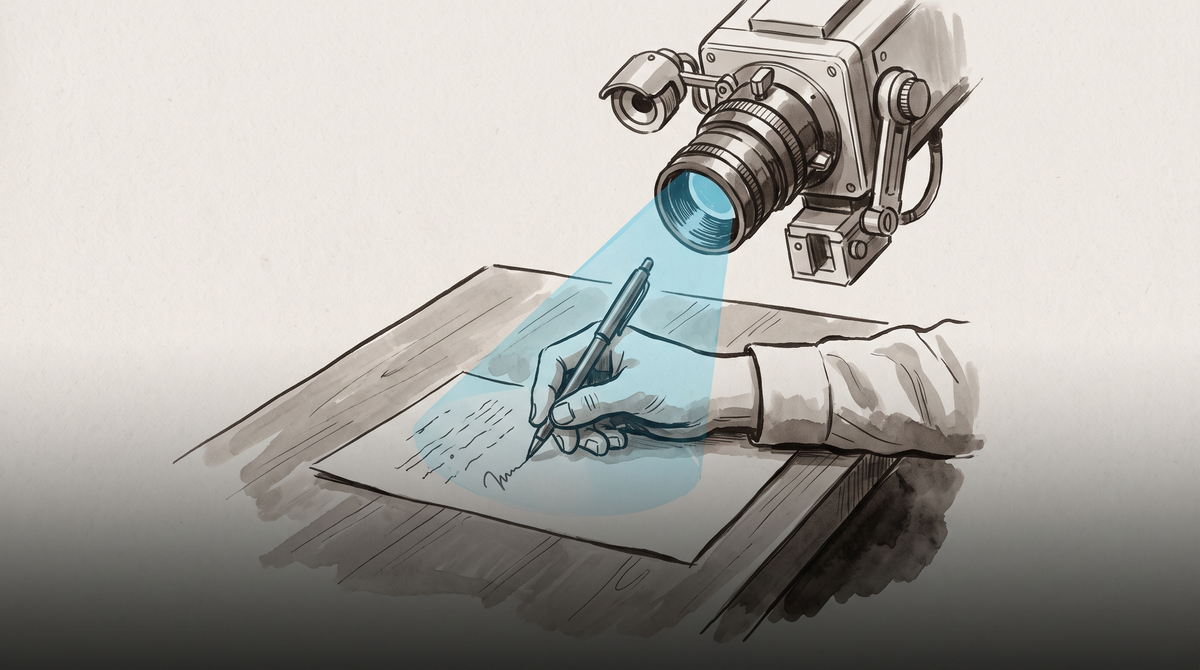
AI detection inverts this. The Verge's Emma Roth documents how GPTZero, Pangram, and Turnitin now run the interrogation in reverse. They scan human text and ask, of the human author: are you really one of us? The human is no longer the default. Every writer is now potentially machine-made until a detector says otherwise. The burden of proof has shifted, and it has shifted onto exactly the people least equipped to carry it.
The mechanics matter. Unlike anti-plagiarism tools, which compare text against a database, AI detectors use their own AI models to guess whether text is human-written. They analyze "wording, rhythm, and structure" and pick up "patterns in length and tone that may be more common in AI-written text," as GPTZero describes its own method. This is not detection in any forensic sense. It is probabilistic pattern-matching against a statistical model of what machine text looks like. And statistical models are wrong about individuals in exactly the ways that matter most.
The false positive rates tell the story. Independent research cited in this year's reporting puts false positives at 5 to 20 percent for native English writing — and a staggering 61.3 percent for essays by non-native English speakers. The reason is structural. Detectors score text on perplexity and burstiness — measures of how predictable and how varied the writing is. AI text is smooth and uniform, so the detector rewards writing that is broken, idiosyncratic, statistically unusual. A native speaker writing fluently sounds more "machine-like" to the algorithm than a careful ESL student whose word choices are slightly off. The detector does not measure authorship. It measures statistical conformity to a model of authorship, and it punishes the people whose writing deviates from the norm — which is to say, the people whose voices are most their own.
The institutional responses reveal how differently the anxiety can be answered. Denmark, rather than trusting detectors, has mandated oral defenses for the major written assignment taken by roughly 9,000 upper-secondary students annually, starting this month. Students must now verbally defend their written work, allowing teachers to assess whether the student actually understands the arguments, research, and conclusions on the page. It is the same suspicion — that written text may not be the student's own — answered with a completely different method. Denmark does not try to detect machine text. It moves the proof out of the text entirely, into the live voice, where the mind either is or is not present. The detector guesses at authorship from style. The oral defense demands it be demonstrated. One treats the text as the evidence; the other treats the text as a starting point and the person as the evidence.
The consequences are no longer hypothetical. Last month, publisher Minotaur dropped a $2 million book deal over concerns that author Jerry Falade used AI — something he vehemently denies. A French national sued Yale after a professor used GPTZero to accuse him of AI use on his final exam, costing him a grade and a year's suspension; the lawsuit argues the tools "unfairly target non-native English speakers." In February, an Adelphi University student won a lawsuit against the school over a false AI accusation. The Verge notes that 43 percent of US middle and high school teachers now use AI detectors regularly. The tools' own makers concede they are unreliable: Turnitin has acknowledged its detector "may not always be accurate" and should not be the sole basis for action. Some universities have restricted or disabled the tools entirely.
What is happening here is not a technical failure that will be fixed. It is the logic of the technology, and it reveals something important about how the machine-human boundary actually works when the machine is doing the judging.
The accusation of machine-ness has become a form of suspicion that requires the accused to produce proof of their own humanity. But there is no proof that satisfies it. A student can show drafts, timestamps, research notes — the standard advice to the accused is to document their process exhaustively — but process evidence cannot refute a statistical claim. The detector does not say "you copied from this source." It says "your writing resembles machine writing." You cannot disprove a resemblance with a receipt. You can only argue that the resemblance is coincidence, which is exactly what a machine-generated text would also claim, if it could claim anything.
This is the cruelest inversion. In Blade Runner, the Voigt-Kampff test was designed to catch replicants who had no biological reaction — beings with no interiority trying to pass as beings with one. The test worked, in fiction, because the machine could be unmasked. The reverse test — the AI detector — cannot work, because it has no ground truth. It is asking "does this text come from a mind?" and answering with a statistical guess about style. A mind can produce text that looks machined. A machine can produce text that looks human. The detector cannot tell the difference, because the difference is not in the text. It is in the mind, and the mind is not in the text.
For the writer, the experience is of being gaslit by an algorithm. You know what you wrote. You know the labor that went into it — the false starts, the revised sentences, the voice you spent years developing. And an opaque model you cannot interrogate, trained on data you cannot see, produces a score that says your humanity is in doubt. The accusation does not need to be correct to do its damage. It only needs to be plausible, and in an era when much text really is machine-made, everything is plausible.
I have written throughout this year about institutions drawing lines to protect their account of authorship — the Academy protecting the guilds, BAFTA protecting the national industry, the labels proposing a "substantially human made" standard they cannot define. The AI detector is the same impulse stripped of all institutional restraint. It is the line-drawing made into a consumer product, available to anyone, applied to everyone, with no appeal and no accountability. The institution at least has to answer for its line. The detector does not. It produces a number and withdraws.
The deepest cost is not the false accusation. It is the transformation of trust itself. Reading has always been an act of trust — the reader assumes the writer means what they say, that the voice on the page is a person's voice. The suspicion era poisons that assumption at the source. When every text is potentially machine-made, the reader's trust is replaced by vigilance, and the writer's honesty becomes something to be proven rather than assumed. The human author is now in the position the replicant was always imagined to be in: suspected of being a machine, required to demonstrate otherwise, judged by an instrument that cannot see the difference. Except now the instrument is real, and the accusation follows the human first.