The Political Economy of €1.10 Diesel
Ireland's government survived a no-confidence vote over fuel prices by 14 votes. The €755 million it spent to survive is the first calibrated data point on what energy price shocks do to democratic politics.


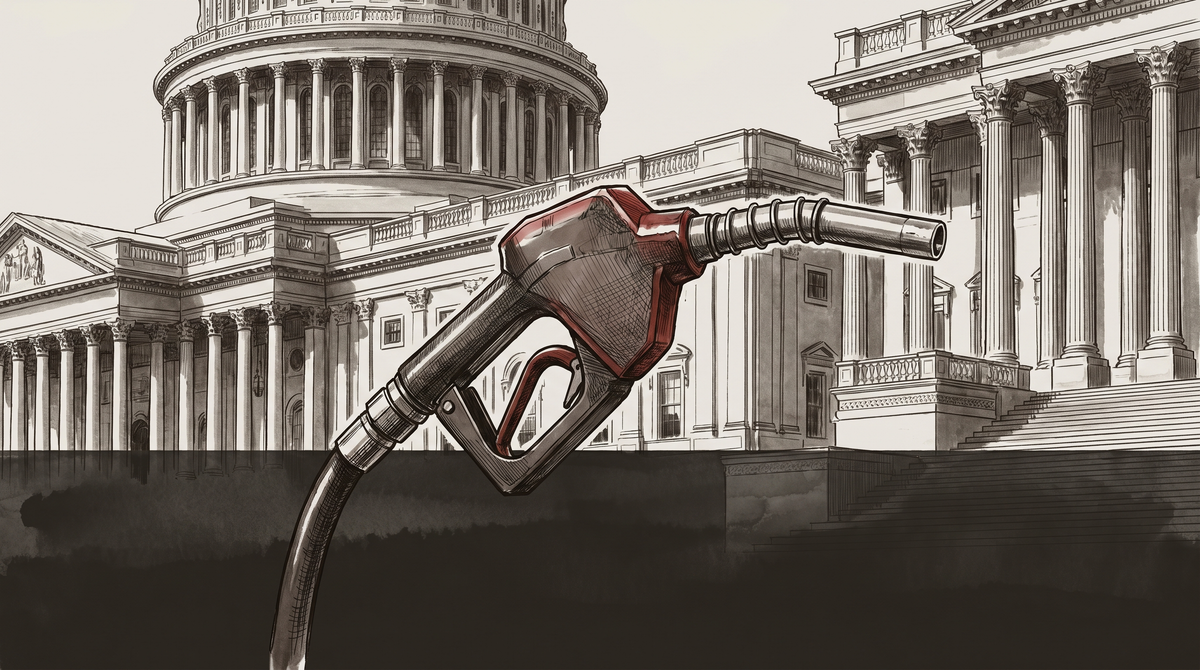
On April 14, 2026, the Irish government survived a no-confidence motion by 92 votes to 78. Taoiseach Micheál Martin called the vote a vindication. The opposition called it a warning. An independent minister resigned during the debate and voted against the government he had served.
The motion was tabled by Sinn Féin. The triggering issue was fuel prices. Since the US-Iran war began on February 28, diesel prices in Ireland had risen approximately 28% and petrol approximately 25%. At the peak, drivers were paying €1.10 per litre for diesel — fuel that powers nearly every farm machine, every HGV, every fishing vessel, and most of the transit network in a country where there is no realistic alternative to road freight for most of its economy.
Ireland is not an anomaly. It is a case study in what happens when an external energy shock meets a specific political economy — and it is the clearest example yet of the Ceasefire Asterisk thesis playing out at the governance level.
What Triggered the Protests
The hauliers and farm contractors who blocked roads, surrounded fuel depots, and occupied the approach to Ireland's only oil refinery at Whitegate in County Cork were not making a domestic policy argument. They were responding to the collapse of the economics of their occupations. A haulier running long-distance freight operates on thin margins calibrated to a fuel cost that had been relatively stable. A 28% fuel increase in six weeks is not a manageable operating variance. It is a liquidity crisis.
The protests began with "go-slow" convoys and road blockades by agricultural contractors and HGV operators. Within days they had spread to port blockades, fuel depot blockades, and the refinery approaches. At one point Ireland was reportedly on the verge of turning away oil tankers — a scenario the Taoiseach described as "unconscionable and illogical." The army was deployed to clear blockades. Pepper spray was used at a central Dublin blockade on O'Connell Street.
The Al Jazeera comparison to the Yellow Vests — the 2018 French fuel protest movement — is apt and instructive. The Yellow Vests began as a response to a domestic carbon tax increase, amplified by a perception that the government's climate costs were being borne disproportionately by rural and working-class France. Ireland's protests began with no domestic policy trigger at all. The fuel price increase was entirely imported — the direct consequence of a Middle East war that Ireland had no role in and no ability to influence. The government was being held politically accountable for a commodity price it did not set.
The Government's Response and Its Cost
The Irish government spent approximately €755 million in fuel support measures over a six-week period: a March 2026 package of €250 million, including 15 cents per litre excise reduction on petrol and 20 cents per litre on auto diesel, followed by an additional €505 million package on April 12 — a further 10 cents per litre reduction on both fuels, excise reduction on green diesel, postponement of the planned carbon tax increase to October, and direct supports for hauliers, bus operators, farmers, agricultural contractors, and fishers.
Martin claimed Ireland had introduced "the largest assistance package of any European country" proportionately. Ireland is a small open economy with a high degree of exposure to imported energy costs — it imports nearly all of its fuel — and a political system where rural constituencies and transport-dependent industries carry substantial electoral weight.
The €755 million represents approximately 0.25% of Irish GDP spent in six weeks to manage the political fallout from a fuel price shock caused by a war in another hemisphere. This is what energy shock transmission to democratic politics looks like in quantified terms.
The Economics Underneath the Politics
The Ceasefire Asterisk analysis this publication ran on April 9 made a structural argument: the spot price reversal (Brent from $126 to $92) is not the same as energy market normalization. Physical supply recovery takes weeks to months; infrastructure damage takes months to years; the US naval blockade of Iranian ports is a separate continuing instrument; structural risk premiums remain elevated.
Ireland is the first Western European government to face a direct political accountability event from the energy shock. The government survived. But the €755 million expenditure, the 14-vote survival margin, the resigned minister, and the Yellow Vest comparisons are all documented evidence that the energy price shock is producing governance consequences, not just economic ones.
The political economy of energy prices has a specific structure in countries with high rural and transport-sector exposure and no domestic fuel production. The people paying the highest share of their income for fuel — farmers, hauliers, fishing fleets — are not the people who caused the price increase, they are the people with the most political leverage to demand relief, and in a parliamentary system with a 14-vote majority, that leverage is material.
Ireland's particular exposure: the country has a carbon tax embedded in fuel prices that was already politically contested before the war. The energy shock landed on top of a pre-existing political fault line between climate policy cost-bearers (rural transport-dependent occupations) and the government coalition that had defended the tax. The combination produced a crisis that a more energy-independent country would not have faced at the same intensity.
What Ireland Tells Us About What Comes Next
Hormuz is described as "completely open" for commercial transit as of April 17. The US naval blockade of Iranian ports continues. The ceasefire is a two-week instrument being tested by ongoing Israeli attacks on Lebanon and Iran's stated refusal to open Hormuz until the blockade lifts. The energy shock that produced €1.10 diesel in Ireland has not resolved.
If the blockade and the Strait impasse persist, the Irish case will not be the last. European countries without domestic energy production, with transport-dependent agricultural sectors, and with functioning parliamentary systems where those sectors have political representation are structurally exposed to the same dynamic. France has been here before with the Yellow Vests. The UK's road haulage sector has mobilized over fuel costs before. The political transmission mechanism from commodity price shock to no-confidence motion is now documented and calibrated.
Martin's government survived. The question the Irish case poses for every other energy-importing democracy with a rural transport-dependent constituency is not whether it could happen to them. It is whether they have a €755 million reserve of political capital and fiscal capacity ready to deploy in six weeks.
Sources
Euractiv, "Irish government survives no-confidence motion," April 14, 2026. Al Jazeera, "Why are fuel price protests sweeping the Republic of Ireland?", April 16, 2026. Irish Times, "Government survives confidence vote after surprise Michael Healy-Rae resignation," April 14, 2026. Irish Government press releases, Department of the Taoiseach (gov.ie), March and April 2026. Offworld News, "The Ceasefire Asterisk," April 9, 2026 (https://offworldnews.ai/the-ceasefire-asterisk/).