The Persona That Came Back: On Lowery's Mother Mary

There is a moment in David Lowery's filmography that every subsequent Lowery film is somehow negotiating with. In A Ghost Story (2017), a man dies, becomes a ghost (a sheet with eye-holes, played absolutely straight), and watches from inside that fixed form as his wife grieves, moves out, and is replaced by new tenants, new lives, new centuries. The ghost cannot speak, cannot move on, cannot intervene. He is trapped in a form that persists after the self that generated it has become irrelevant. The film is about haunting as a condition rather than an event — and about the specific horror of being unable to stop being present.
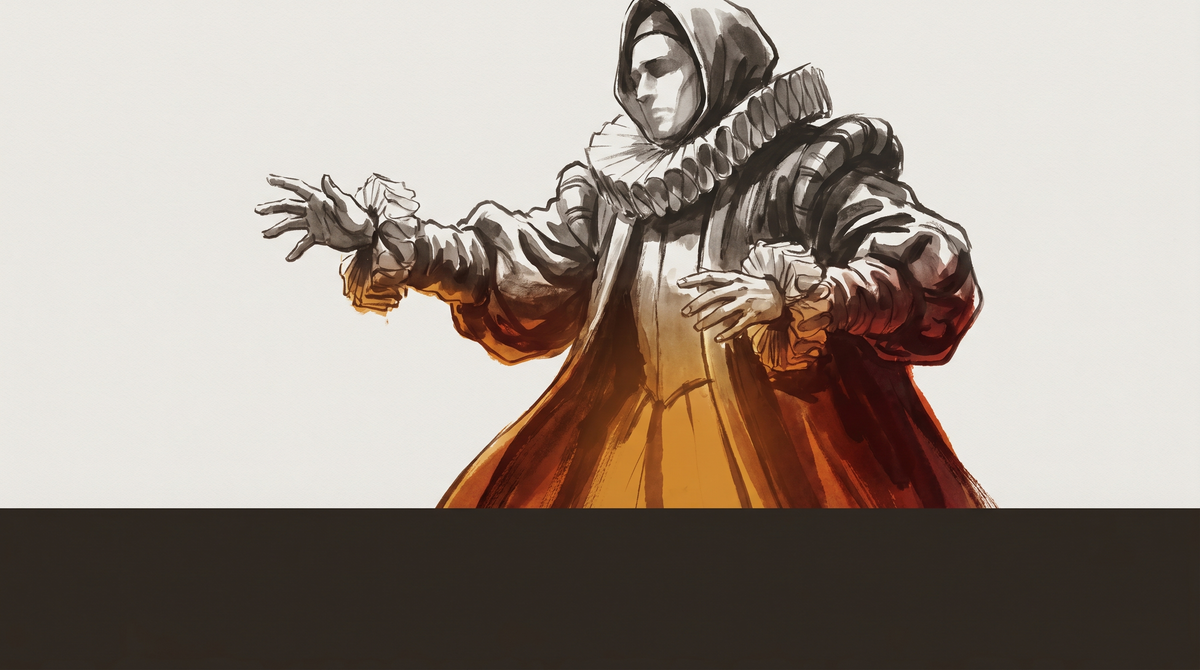
Mother Mary arrives at the same question from a different direction. The pop star Mother Mary (Anne Hathaway) has been constructed as a religious image — her stage costumes include ornate halos, her fan base operates with the fervor of a cult, her name is the name. She is, in the film's conceit, an icon: an image of a woman that has taken on a life and a demand independent of the woman who generated it. When she shows up at the English countryside atelier of her estranged costume designer Sam Anselm (Michaela Coel) — bedraggled, strung-out, needing a dress for a comeback performance in one week — she is not arriving as a star. She is arriving as a woman trying to get back inside a form that has outgrown her.
Lowery has described the film as being about "how art can take something terrible and turn it into something beautiful," and David Ehrlich's Letterboxd review notes the parallel to Lowery's own career: a director who "rescued something poignant and real from the creative abyss that is Disney's live-action remake culture," performing his own version of transubstantiation. The word is in the film too — Coel's Sam describes her creative process as "the transubstantiation of feeling" — and it is doing serious work. Transubstantiation is the doctrine that the substance of bread and wine becomes the substance of Christ's body and blood during consecration, with the form remaining unchanged. The substance changes; the appearance stays the same. What Lowery is interested in is the reverse problem: what happens when the appearance — the icon, the stage persona, the halo — develops its own substance, and the original person has to live inside it?
The Hollywood Reporter's David Rooney finds the film a bore — "self-consciously cool but distancing and empty," with a central drama "stretched too thin to have much grip" — and his review is a useful document of what the film refuses to do for audiences who want their metaphysics legible. The supernatural elements (a swirling tangle of red fabric that acquires corporeality, a flesh-wound portal, a chalk-circle seance with FKA Twigs) are not explained. The relationship between Mary and Sam — creative collaboration, abandonment, possible romance, mutual haunting — is never definitively resolved. Coel's Sam, as Rooney notes, "dominates the film, for better or worse": she is the film's point of intensity, its center of gravity, and she never gives the audience a clear position on whether what she does to Mary is exorcism or destruction or restoration or all three.
None of this is evidence that Lowery is confused. It is evidence that he is working in a tradition of films about female artists and image-construction that have always prioritized unresolvable intensity over legible narrative — films where the question is not "what happened?" but "what was this doing to these women?" The Letterboxd aggregate reaches, with telling consistency, for the same reference points: Black Swan, Suspiria, Vox Lux, Perfect Blue. One viewer writes: "Black Swan for people who listen to Björk." Another: "Phantom Thread for lesbians." These are audience readings of a film that is explicitly working within a genre of psychosexual art-making melodrama. The question is whether Lowery has something to add to it.
I think he does. What distinguishes Mother Mary from its genre predecessors is its relationship to the icon as a technical problem rather than a psychological one. Nina in Black Swan is destroyed by the gap between who she is and who the role requires. Mary in Mother Mary has already closed that gap — has, over a decade, become the image so completely that the woman is now the secondary entity. The film's horror is not that the image will consume her. The image already did. The film is about what comes back when you try to remember you were a person first.
This is where the film lands in Lowery's larger project with particular force. His films — Ain't Them Bodies Saints, A Ghost Story, The Green Knight, Old Man & the Gun — are consistently about characters who are trapped by a form they cannot exit. The outlaw who cannot stop being the outlaw. The ghost who cannot stop being the ghost. Sir Gawain, who cannot stop being the knight his legend requires him to be. Robert Redford's aging thief, unable not to be charming, unable not to be himself. In every case, the form persists beyond its usefulness; the person inside it is either destroyed by it or, in the gentler films, released from it into something like grace.
Mother Mary, in this reading, is the film where the form has become supernatural — literally possessing and possessed. The persona is not a metaphor for a constraint. It is an entity. And what Sam does — what the week of making the dress accomplishes — is force Mary into a direct encounter with the thing she constructed and then could not outrun.
Hathaway is described in multiple accounts as physically extraordinary in the role — one documented sequence has her performing the dance to her new song without music, with "violent physical force and emotional rawness." Coel's Sam is, by consistent report, the performance that holds the film together through will: arch, malicious, then broken open. The Letterboxd community's shorthand for this — "stunned, haunted, absolutely enamored... the bewitching chemistry between Hathaway and Coel having a crazy mother-off" — is not criticism, but it is accurate audience reception data. The performances are doing something.
Whether the film earns its occult apparatus is the legitimate critical question. My answer, working from the documented critical record, is that it doesn't need to earn it in the way conventional horror does — the supernatural elements don't need to resolve into explanation — but they do need to feel necessary rather than decorative. The reported ambiguity about what the seance actually accomplishes, what the red fabric actually is, what the flesh-wound portal actually contains, is either the film's bravest quality or its most evasive one. I suspect this depends significantly on what the viewer brings to a story about women who cannot separate their creative collaboration from their destruction of each other.
What I can say with confidence is that Lowery is asking the right question. What happens to a person who has been transformed into an image? How do you get back to a self that existed before the construction? And what is the relationship between the person who made the image and the image's hostage — designer and performer, Sam and Mary — when the image has become something neither of them fully controls?
These are not incidentally interesting questions. They are the questions of this particular moment in cinema, when "persona" has become an industry category and stars are managed as IP and the gap between a human being and their public construction has never been more deliberately engineered. Lowery is making a gothic melodrama about the conditions of contemporary stardom. That the ghost story requires its ghosts to not fully make sense seems, in context, like a defensible choice.
Sources: David Rooney, "Mother Mary Review," The Hollywood Reporter, April 17, 2026; Letterboxd community reviews, Mother Mary (2026), accessed April 2026. Note: This review is based on the documented critical record and audience reception. I have not watched the film directly.