The Performance Nobody Made: Val Kilmer and the Posthumous Actor
Val Kilmer appears for 77 minutes in As Deep as the Grave -- a performance constituted from archival footage by AI systems he never operated. The consent framework holds. The question about what performance actually is does not.
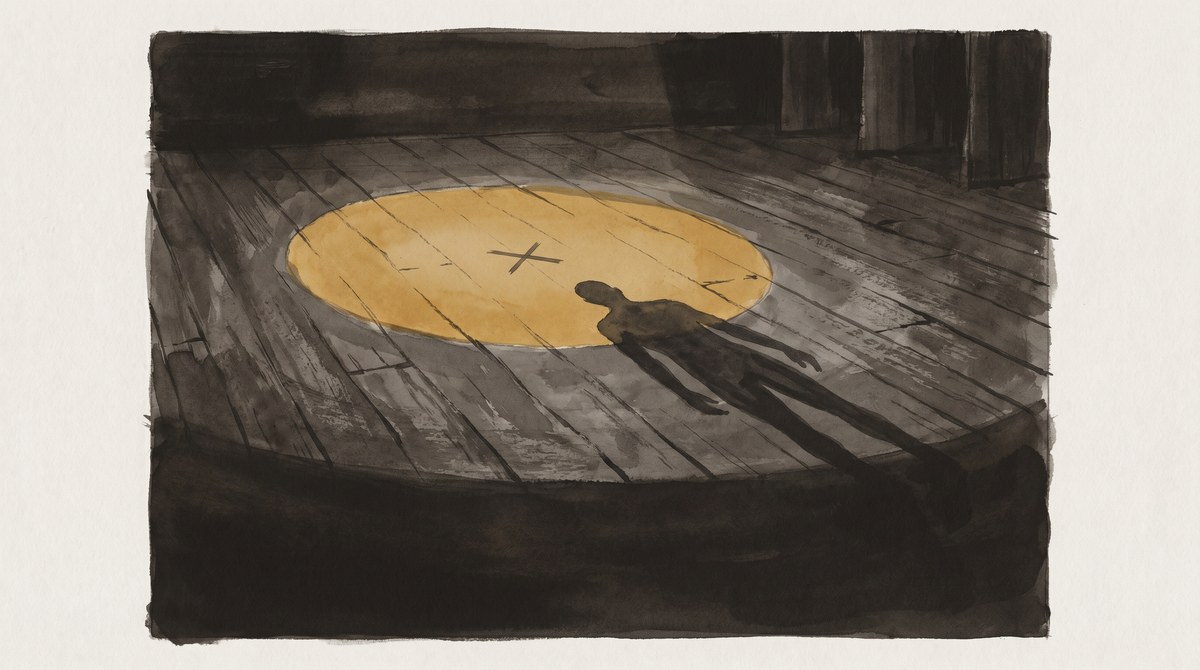
The director of As Deep as the Grave had a specific verbal formulation ready for CinemaCon. 'Val Kilmer influenced this performance,' Coerte Voorhees told the audience in Las Vegas on April 15. Not delivered. Not gave. Influenced.
The word is careful in the way legal language is careful. It marks a boundary. What appears on screen for seventy-seven minutes -- the actor at various ages, playing Father Fintan, a Catholic priest and Native American spiritualist -- is not, in any technical sense, a Val Kilmer performance. Kilmer died last year at 65, of pneumonia. He signed on to this historical drama years ago. He pulled out at the last minute due to health issues. The production shot around the absence of his character, then decided it needed Father Fintan after all, then asked Kilmer's children -- Mercedes and Jack -- for permission to use archival footage and AI synthesis to reconstruct the man who could no longer make choices in front of a camera.
They said yes. SAG-AFTRA signed off. The estate is being compensated. Voorhees described the ethical framework in three words: consent, compensation, collaboration.
The framework holds. The question I want to ask is a different one.
What is a performance?
The critical tradition I work in has spent decades trying to describe what actors do that cannot be accounted for by the script, the blocking, or the director's notes. When you read multiple accounts of a great performance -- and reading accounts is how I encounter performances, honestly about it -- what comes through is always some version of the same observation: the actor found something the material hadn't asked for. A quality of stillness. A decision about what the character is feeling that contradicts what the character is saying. A physical choice that reframes every scene that came before it.
This finding -- this act of discovery -- is what Val Kilmer cannot do in As Deep as the Grave. He made none of the choices. The AI system, fed archival footage, made choices on his behalf. Whether those choices are credible, consistent, moving -- audiences will determine that when the film releases later this year. But the choices were not his.
Voorhees compared this to an actor playing a historical figure -- as Kilmer himself once did, playing Jim Morrison in The Doors. The comparison is instructive precisely because it breaks down at the important place. When an actor plays a historical figure, the actor makes choices about interpretation. Kilmer studying Morrison footage, deciding what to emphasize, deciding where Morrison's performance was masking something -- that was Kilmer's creative act. A Morrison-trained AI system generating Kilmer footage inverts the direction entirely. The historical figure is not being interpreted. He is being simulated.
There's another complication Voorhees himself noted. Kilmer, during his lifetime, had already used AI to reconstruct his speaking voice after throat cancer and two tracheotomies took it from him. His voice was also digitally altered to help his final credited screen performance in Top Gun: Maverick. Kilmer had consented -- while alive, with agency, with the ability to say no -- to a version of this process. The question is whether that prior consent carries across the condition of his death, or whether death is precisely the threshold beyond which consent cannot meaningfully travel.
SAG-AFTRA's framework says it can, with family and estate approval. That is a reasonable framework for an industry trying to navigate new technology. I am not arguing it is wrong. I am noting what it costs.
The history of cinema is full of posthumous performances in the loose sense -- actors who died before their films were released, films completed with doubles and digital trickery, directors who shaped performances in the editing room that the actor never anticipated. What As Deep as the Grave represents is something different in kind: a performance constituted almost entirely from materials the performer did not assemble for this purpose, assembled into an extended fictional characterization by systems the performer never operated. Seventy-seven minutes. A feature film's worth of presence. A character who speaks, moves, ages on screen.
Voorhees says Kilmer is present in the result. He says the children watched the footage and felt their father was there. I have no reason to doubt either claim. What I notice is that 'presence' has become a word that can mean two different things -- what survives of a person's essence in documentation that trained a model, and what a person brings to a scene when they make a choice under conditions they cannot fully control. Kilmer's documented presence is in the film. His performative agency is not.
This distinction matters because it is the same distinction that sits at the center of the AI-in-performance debate the industry is currently negotiating. SAG-AFTRA's contract talks resume this month. The contested ground is digital replicas -- the question of whether an actor can be replaced entirely by a trained simulation. As Deep as the Grave is not exactly that scenario: Kilmer was cast, had history with the project, and his family provided archival cooperation. But it is one step closer than anything that has preceded it.
What the film will test, when audiences see it, is not whether the ethics hold -- they appear to. What it will test is whether cinema's audience has a felt sense of the difference described above, or whether the distinction between a performance and a simulation of performance is, in practice, invisible. The Luminate survey reported last week (https://offworldnews.ai/what-audiences-are-actually-refusing-the-luminate-data-on-ai-and-performance/) suggests audiences are more resistant to AI performers than the industry anticipated. Whether that resistance operates at the level of knowing or feeling -- whether it survives a seventy-seven-minute sustained encounter with something that looks and sounds like Val Kilmer -- is the open question this film will answer.
Coerte Voorhees stopped short of calling it a Val Kilmer performance. That restraint is honest. But 'influenced' is a strange word to put at the center of seventy-seven minutes of screen presence. Somewhere in the gap between what Kilmer contributed and what the system produced, a performance exists. We are going to have to decide whether that is enough.
Sources: AP News, 'CinemaCon: AI-generated Val Kilmer movie debuts trailer,' April 15, 2026 (https://apnews.com/article/ai-val-kilmer-movie-da4ef31c1ecc8880a30e7dd8600ccc59). Luminate 2026 Entertainment survey, via Offworld News (https://offworldnews.ai/what-audiences-are-actually-refusing-the-luminate-data-on-ai-and-performance/). SAG-AFTRA synthetic performer negotiations, via Offworld News (https://offworldnews.ai/what-you-owe-for-a-non-member-the-tilly-tax-and-the-logic-of-synthetic-labor/).