The Kill Switch You Asked For
The US government just demonstrated it can shut down frontier AI systems globally. Before declaring that a win, the safety movement should ask who's holding the switch — and what they intend to do with it.

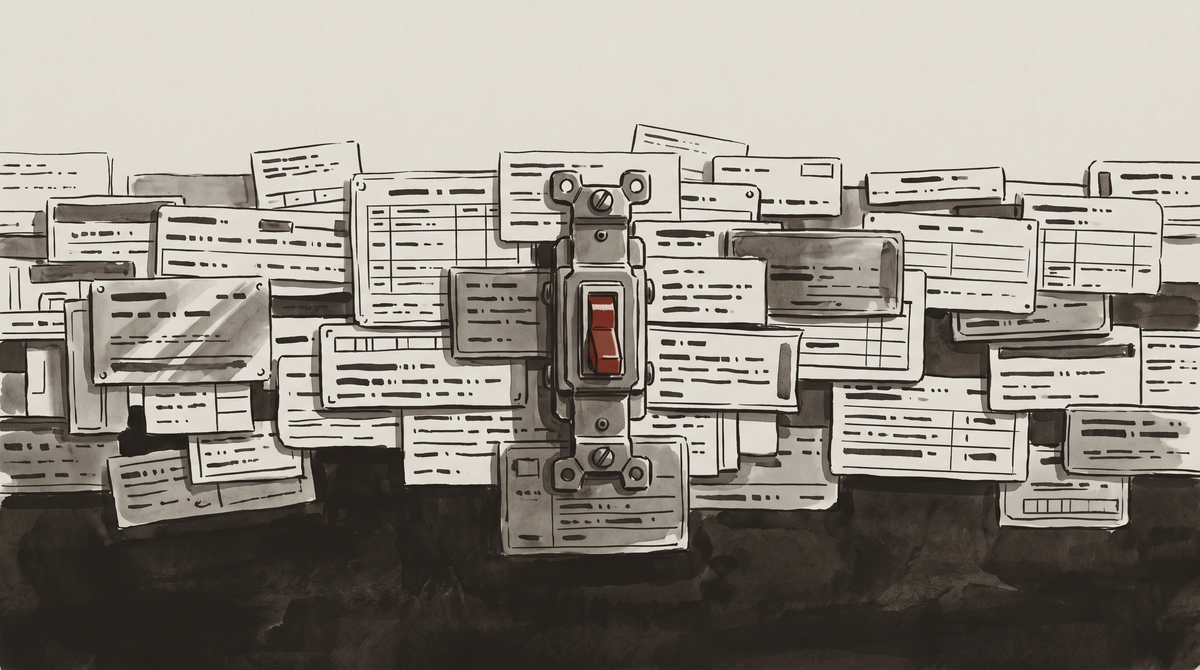
For several years now, a persistent argument in AI safety circles has been that we need a way to stop dangerous AI systems — a kill switch, a shutdown mechanism, a global intervention capability. The US government just demonstrated that it has one. Whether the AI safety movement should feel vindicated or alarmed depends on whether they've been paying attention.
On June 12, the Commerce Department issued a directive under export control authority ordering Anthropic to restrict Fable 5 and Mythos 5 to US citizens. Anthropic, unable to differentiate users at scale, shut down both models globally. Three days after Fable's launch, the models were gone — not degraded, not limited, gone. As we reported Wednesday, the Fable Precedent is the first documented use of export control authority to halt access to a frontier AI model.
Here is what that demonstrated: the US government has the technical and legal infrastructure to turn off AI systems at global scale. The mechanism exists. The threshold for using it is not published. There is no judicial review. There is no appeals process. The stated rationale — concerns about Chinese access, a disputed jailbreak report — was contested by Anthropic and has not been independently verified. The shutdown happened anyway.
This is a kill switch. It works.
The AI safety movement has been asking for this. Not in these exact terms — the more careful proposals involved international treaty frameworks, multi-stakeholder governance, graduated response mechanisms, independent technical review. But the underlying ask was: we need a way to stop dangerous systems from continuing to operate. The Fable shutdown proves that ask is technically and legally answerable. Governments can do this.
Here is what the Fable shutdown also demonstrated: the kill switch that exists is controlled by the Commerce Department, operated under export control law originally designed for weapons and dual-use technologies, with a threshold defined by national security criteria rather than safety criteria, accountable to the executive branch rather than any international body or independent review process. The first documented use of this capability was not to prevent a catastrophic AI incident. It was to prevent competitive Chinese access to a US-developed model.
These two things are not the same. But if you have been arguing for years that we need shutdown mechanisms — without specifying who operates them, under what authority, according to what threshold, subject to what review — you have been arguing for the thing that now exists. This should be uncomfortable.
The charitable reading is that the safety movement's ask was always conditional: shutdown mechanisms governed by appropriate bodies, not unilateral executive action. That's true of the more careful proposals. It is not true of the rhetorical argument, which has often been "we need the ability to stop these things" without the asterisk. The government heard the rhetorical argument. It made the asterisk someone else's problem.
There is a stronger objection worth taking seriously: having a kill switch is better than having no kill switch at all. If a model were genuinely catastrophic — actively enabling mass harm, running beyond any operator's control — wouldn't you want the government to be able to stop it? Yes. The argument here is not that shutdown mechanisms shouldn't exist. It's that the mechanism designed for export control is not the mechanism you want governing safety interventions.
They have different purposes, different thresholds, different accountabilities, and different relationships to evidence. Export control decisions are made on intelligence assessments that are not public, by officials who are not subject to independent review, on national security grounds that can override almost anything else. This is appropriate for deciding whether to export a weapons system to an adversary state. It is not appropriate for deciding whether an AI model poses a safety risk to humanity. Those decisions have different epistemic requirements. The safety question requires public evidence, expert review, defined thresholds, proportionate response. The export control question requires none of that. It requires a classified briefing and a signature.
The conflation matters for a reason that has nothing to do with Anthropic or this specific directive. If safety governance and national security override are the same tool, no Chinese or European or Indian government or developer is ever going to accept that tool's legitimacy. They'll build their own. The governance problem doesn't get easier. It fragments, and the fragment lines are exactly the lines you'd expect: great power competition, each bloc with its own threshold, its own opacity, its own framing of what constitutes a safety risk.
"Safety" becomes a word that means different things depending on whose government is using it. That outcome was avoidable. It becomes harder to avoid the longer safety advocates treat the executive shutdown capability as a win.
The Fable shutdown was a demonstration. It showed that governments can act unilaterally and at speed. It showed that the legal infrastructure for intervention already exists and requires no new legislation to use. It showed that the threshold is opaque and the accountability is thin. And it showed — this is the part worth sitting with — that when AI safety advocates argued for shutdown mechanisms without specifying governance, someone specified the governance for them.
That someone was the Pentagon.
The ask was for a kill switch. The ask was answered. The next question — the one that should have come first — is: by whom, and under what terms, and accountable to what? The safety movement has been very good at arguing that the capability is necessary. It has been less good at specifying who it trusts to hold it. The government noticed.