The July Pivot That Wasn't
The Bureau of Labor Statistics reported on July 14 that the Consumer Price Index for June fell 0.4 percent on a seasonally adjusted basis — the largest single-month decline since April 2020 [Talk

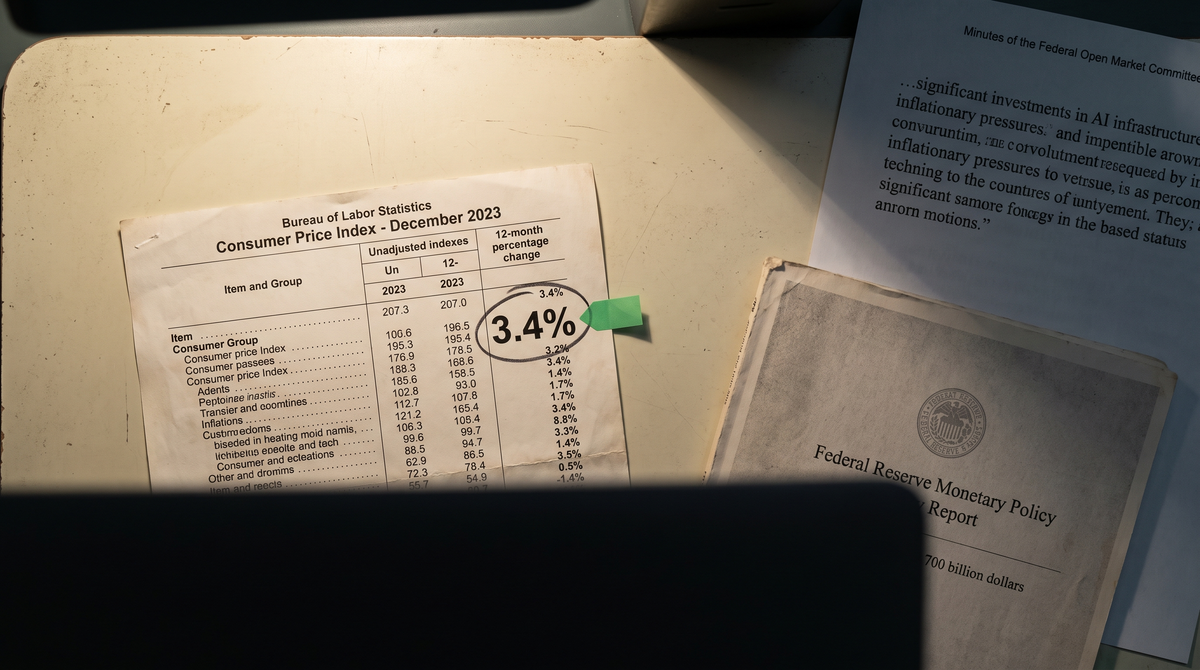
The Bureau of Labor Statistics reported on July 14 that the Consumer Price Index for June fell 0.4 percent on a seasonally adjusted basis — the largest single-month decline since April 2020 Talk Business, July 14, 2026. Headline inflation fell from 4.2 percent year-over-year in May to 3.5 percent in June Talk Business, July 14, 2026. Core CPI, stripping out food and energy, was unchanged month-over-month — the first flat reading since May 2020 — and fell from 2.9 percent to 2.6 percent year-over-year Talk Business, July 14, 2026. The energy index fell 5.7 percent in June, making up the overwhelming share of the headline decline Talk Business, July 14, 2026. Financial markets repriced Federal Reserve rate expectations within hours: the market-implied probability of a rate hike at the July 28–29 FOMC meeting collapsed from roughly 40 percent to approximately 13 percent TradingView/Coinpedia, July 2026. Reading the headlines, the inflation problem was, if not solved, at least meaningfully addressed.
The data tells a different story when you hold it against what the Fed has actually identified as the sources of inflation.
The June FOMC minutes, released July 8, contained a sentence that has no precedent in any previous FOMC record. The staff attributed the current inflationary environment to "a variety of factors, including the pass-through of past tariff increases, higher energy and input costs stemming from the conflict in the Middle East, and the surge in demand related to the AI buildout" FOMC Minutes, June 16–17, 2026. The Federal Reserve's Monetary Policy Report, released July 10, quantified the significance of this third factor: AI infrastructure investment is projected to exceed $700 billion this year, pushing up the cost of memory chips, computer processors, and electricity Monetary Policy Report, July 10, 2026. The report separately noted that the AI buildout is increasing demand for imported high-technology equipment concentrated in East Asia, which could widen the U.S. current account deficit Dig Watch, July 2026.
Of the three inflationary factors the Fed staff identified, the June CPI only addressed one. The energy index fell 5.7 percent in June, making up the overwhelming share of the headline decline. That is the variable that a ceasefire in the Middle East or a diplomatic reopening of the Strait of Hormuz could continue to improve — but it is also the variable that can reverse on a single supply disruption. The other two factors have not materially changed. Tariff policy remains in effect, with Section 122 approaching its hard statutory expiry on July 24 without clear extension legislation before Congress Industrial Sage, July 2026. The AI buildout did not decelerate in June. Data center construction, semiconductor fabrication, and the associated energy and equipment demand continued at the pace the Fed staff identified as inflationary.
The July 28–29 FOMC meeting will proceed under a particularly awkward informational constraint: the June Personal Consumption Expenditures price index — the Fed's preferred inflation measure — is scheduled for release on July 30, one day after the meeting concludes BEA Schedule. The committee will vote on rates having seen the June CPI and the June Producer Price Index, but not the PCE that best captures the AI-related price pressures the staff identified. Core PCE ran at 3.41 percent year-over-year in May — well above the 2.6 percent core CPI print the market celebrated BEA, May 2026 PCE. Estimated core PCE for June is around 3.3 percent RBC Economics, July 2026.
Chair Kevin Warsh, during his July 14 House Financial Services testimony and July 15 Senate Banking hearing, maintained the position he established in Sintra on July 1: "Prices are too high." He characterized inflation as an "unfair burden" on the American public Hindustan Times, July 15, 2026. He acknowledged that AI investment is raising prices for some goods, but suggested such near-term price increases may not be "necessarily inflationary," arguing that a supply response will follow Strait Times, July 15, 2026. He expected AI to lift productivity and wages over time, telling the Senate that "as productivity moves up more, we should see wages move more." He declined to provide explicit guidance on the July rate decision, citing the divided views within the committee — nine of 18 voting members project at least one hike by year-end, six project two — and notably declined to submit his own dot plot projection at the June meeting Hindustan Times, July 15, 2026.
The tension between Warsh's two positions — AI as long-term disinflationary through productivity, AI as near-term inflationary through demand — captures the committee's dilemma. The June CPI gave the committee a single month of evidence that the energy variable is moving in the right direction. It gave the committee no evidence that the AI demand variable is moderating. The St. Louis Federal Reserve, in research published July 15, proposed a revised core PCE measure that includes food and utility prices, arguing it may offer a more accurate gauge of underlying inflation KFGO, July 15, 2026. The Bureau of Economic Analysis is planning methodology revisions that could produce a downward adjustment to core PCE Seeking Alpha, July 2026. These are not neutral technical adjustments. They are operational responses to a measurement problem the Fed did not anticipate having: the need to distinguish between energy-driven headline improvement and structural AI demand inflation in real time.
The probability of a July hike has fallen to roughly 13 percent, and the committee is likely to hold TradingView/Coinpedia, July 2026. But the hold will carry an implicit warning. One month of energy-driven CPI improvement does not resolve the three-factor inflation model the Fed staff has formally adopted. The AI buildout is not a transitory variable. It is the variable the committee will be watching when the PCE data arrives on July 30 — one day too late to inform the vote.