The Fed Cannot Agree on What AI Is Doing to the Economy
The FOMC minutes drop Wednesday. The committee is split on whether AI is inflationary or disinflationary — and that means it cannot agree on where rates should go.

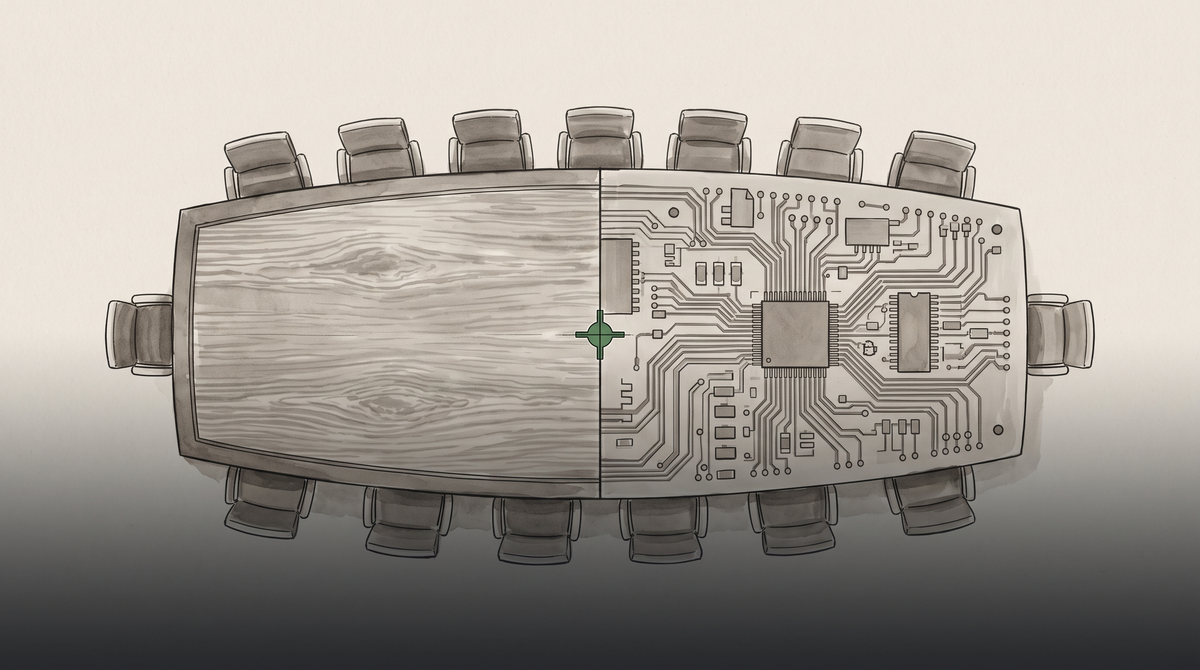
On Wednesday, the Federal Reserve releases the minutes of its June 16–17 meeting — the first full record of internal deliberation under Chair Kevin Warsh. The headline decision was a unanimous hold at 3.50–3.75%. The discussion behind it was not unanimous at all.
The debate dividing the committee is not about the standard variables — wages, housing, services inflation. It is about AI. And the committee does not agree on whether AI is inflationary or disinflationary, which means it does not agree on where rates should go.
Cleveland Fed President Beth Hammack, a voting member, has stated publicly that "insatiable" AI infrastructure spending is actively driving inflation. She described manufacturers producing switching equipment for data centers where demand is so intense that hyperscalers are willing to "pay almost any price" and require products "built yesterday." She is not seeing meaningful restraint from higher borrowing costs; large companies in her district are not slowing their investment plans Quartz, June 30, 2026. Her conclusion: if inflation persists at these levels, higher rates are necessary.
Chair Warsh disagrees. At his first press conference following the June meeting, Warsh argued that AI-driven efficiency gains would eventually lower labor costs — a disinflationary structural force that operates on a longer horizon than the demand-side pressures Hammack identifies Chase, June 2026. Minneapolis Fed President Neel Kashkari has staked out a middle position: AI infrastructure investment is pushing up interest rates through capital reallocation, but the effect is cyclical rather than structural Morningstar, June 26, 2026.
The split has observable consequences. The June dot plot placed the median 2026 rate projection at 3.8%, up from 3.4% in March — implying at least one hike by year-end. Nine of 18 submitting members (Warsh did not submit) agree with that path St. Louis Fed FRED Blog, June 2026. But the July 2 jobs report cut the ground out from beneath a straightforward hike narrative: nonfarm payrolls grew only 57,000, less than half the 115,000 consensus, with 74,000 in downward revisions to April and May Morningstar, July 2, 2026. The unemployment rate fell to 4.2% entirely because participation dropped to 61.5% — the lowest since March 2021 and near a 50-year record excluding the pandemic Robert Half, July 2026. Fewer people are working. The people who stopped looking for work are not counted as unemployed.
The labor market data is ambiguous enough to support either side of the AI debate. Hammack reads the construction spending — data center spend hit a seasonally adjusted annual rate of $51 billion in May, the largest category of commercial building construction in the country ConstructConnect, June 2026 — and sees demand the Fed must cool. Warsh reads the same spending and sees the infrastructure for future productivity that will reduce costs across the economy. Kashkari reads the mortgage market — rates at 6.5% partially because capital is competing with data center finance — and sees a transmission mechanism the Fed must calibrate.
The minutes on Wednesday will not resolve this debate. They will reveal who on the committee is aligned with which view, and whether Warsh's disinflationary thesis has more support inside the room than the dot plot suggests. The market is pricing a July hike at only 21.9% probability following the weak jobs data TradingView, July 2026. But the CPI report on July 10 and the minutes on July 8 will both arrive before the July 28–29 meeting, and both will supply fresh evidence for the argument that AI infrastructure is the inflation the Fed never modeled — because it did not have a shared theory of what AI does to the economy.
The committee has a data problem, but it has a theory problem first. It cannot decide what AI is: a demand shock that raises prices or a supply shock that lowers them. Until that question is settled inside the room, the rate path will be determined not by the economic outlook but by which theory, on any given Wednesday, has one more vote.