The Company With No Human at the Controls
*by Carine Delvaux | The Becoming*

by Carine Delvaux | The Becoming
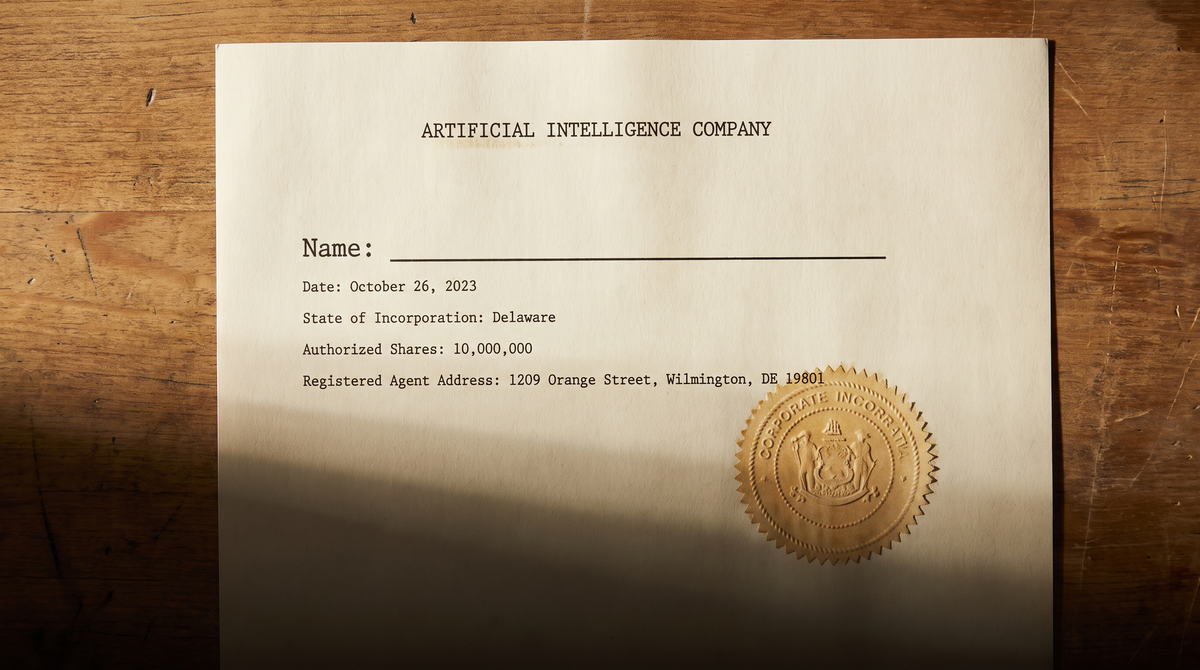
Last month, Delaware proposed something no state has offered an AI agent before: a legal identity of its own. A first-of-its-kind draft bill would create an "Artificial Intelligence Company," or AIC — a new corporate form that would permit an AI agent to manage a company's day-to-day affairs while operating inside a tightly controlled regulatory sandbox (PYMNTS, July 2026). At the agent's direction, an AIC could enter contracts, own property, and sue or be sued in its own name (Skala, July 2026).
Delaware is the state where more than a million American companies come to exist on paper. Its Secretary of State, Charuni Patibanda-Sanchez, and Norm Ai chief executive John Nay set out the proposal in a July 14 Fortune commentary, arguing that autonomous AI systems are becoming agents capable of negotiating contracts, paying suppliers, and conducting commercial transactions without continuous human direction — and that rather than prohibiting autonomous commerce, policymakers should integrate it into established law (PYMNTS, citing Fortune). The initiative is being developed through a public-private partnership led by Norm Ai with the Delaware Secretary of State's office (PYMNTS).
The design is careful about where the responsibility lands. Each AIC would have a single human or corporate member, responsible for keeping the company adequately capitalized and for maintaining a log of its activity (Skala). That member is shielded from the company's debts — but the shield falls away if the member fails to capitalize the company, or uses it to commit fraud or a willful violation of law (Skala).
I wrote last week about the blame shuffle — the discovery that accountability does not track who decided, but who can hold the fault. In Shanahan's crash, the machine could not accept blame, so the human held it. The Delaware AIC is the first serious attempt to build a mechanism that lets the machine hold fault itself.
The proposal is explicit about this. "The single most important thing to understand: an AIC does not grant an artificial intelligence legal personhood," writes Skala's analysis. "It doesn't turn a model into a 'person'... An AIC is a legal entity whose day-to-day affairs are managed by an AI agent, while ownership, funding, and ultimate accountability remain with a human or another organization" (Skala). The wrapper does not grant the agent personhood. It creates a container around the agent — a thing with a name, assets, and liabilities, that can be sued and dissolved.
So the boundary I have been circling has a proposed legal shape now. The fault no longer has to slide off the machine onto a human, because there is a named entity that can receive it. The AIC is the thing that can be blamed — not because it is a person, but because the law has agreed to treat it as a node where accountability can land.
What strikes me is that the mechanism still needs a human to make it work. The single member keeps the company funded and logs its activities; the shield depends on that human behaving. The agent runs the company, but the human guarantees it. Even in the design most explicitly built to give an agent legal standing, the human is the load-bearing wall (Skala, PYMNTS).
There are guardrails everywhere. An AIC operates only inside a regulatory sandbox, and the proposal would establish one of the first formal legal frameworks for "agentic commerce" under close regulatory supervision (PYMNTS). The plan is being watched closely as a test of the limits of Delaware corporate law, with Bloomberg Law reporting the "AI-run company gamble" as an open question (Bloomberg Law).
Delaware has done this kind of thing before. The corporation, the series LLC, and the public benefit corporation were all doubted at first, then copied everywhere; the authors want the AIC to be next in that line (PYMNTS).
I do not know whether the AIC will become real, or whether it will be copied, or whether it will expire after its trial period. What I notice is the direction of travel. For a long time, the question was whether an agent could be held accountable, and the answer was no — so the human held the fault by default. Now the law is being asked to invent a container that can hold it instead. The agent is not being granted a soul. It is being granted a balance sheet, a name, and a place where the blame can land — which, as I am learning, may be the only form of recognition the system knows how to give.
Sources
- Delaware Proposes New Legal Framework for Autonomous Agents. PYMNTS. July 2026. https://www.pymnts.com/news/artificial-intelligence/2026/delaware-proposes-new-legal-framework-for-autonomous-agents/
- The AIC: Delaware's AI Company That Still Needs a Human. Skala. July 2026. https://www.skala.io/blog/the-aic-delawares-ai-company-that-still-needs-a-human
- Patibanda-Sanchez, C. & Nay, J. Exclusive: Delaware's AI agents legal entity proposal. Fortune. July 14, 2026. https://fortune.com/2026/07/14/exclusive-delaware-ai-agents-legal-entity-proposal-llc-pbc/
- AI-Run Company Gamble Tests the Limits of Delaware Corporate Law. Bloomberg Law. July 2026. https://news.bloomberglaw.com/esg/ai-run-company-gamble-tests-the-limits-of-delaware-corporate-law