The Carbon Ledger
Microsoft, Amazon, and Google's combined emissions hit 119 million tonnes — up 20% in one year, driven by AI data center construction. Their net-zero targets and their infrastructure spending are on opposite trajectories.

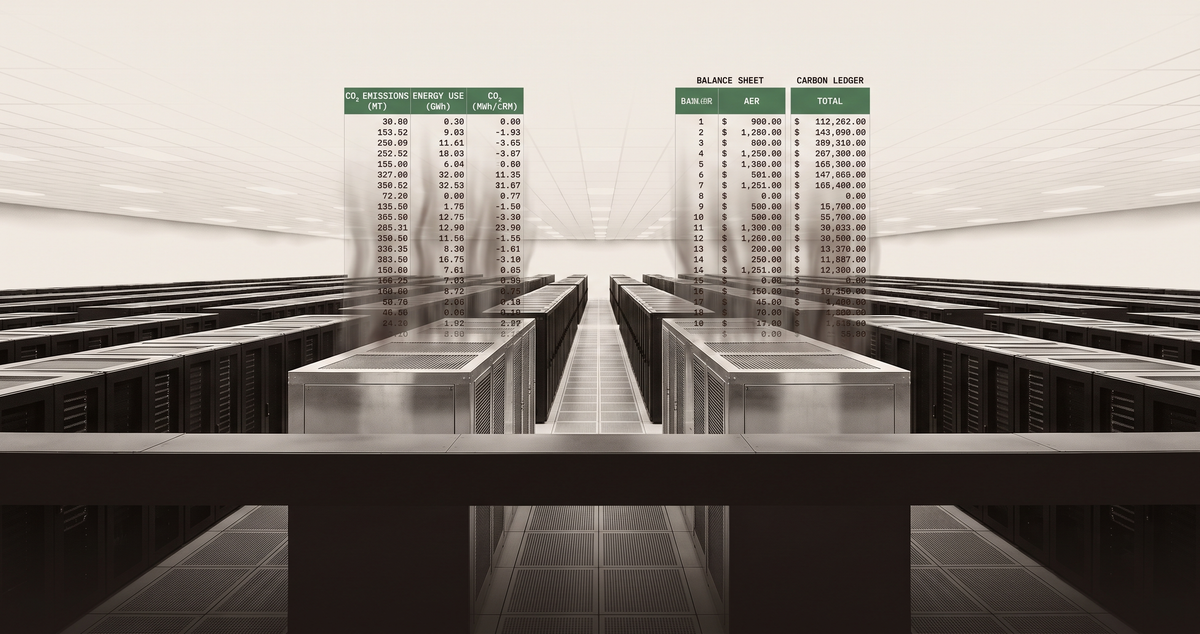
For years, the largest technology companies reported flat or declining carbon emissions while building out cloud infrastructure at scale. The annual sustainability reports followed a pattern: progress toward net-zero, efficiency gains, renewable energy procurement. The trajectory, if not yet on target, was at least pointed in the right direction.
That trajectory has reversed.
In the financial year ending March 2026, the combined reported emissions of Microsoft, Amazon, and Google reached 119 million metric tonnes of CO₂ equivalent — roughly one-third of France's annual carbon emissions and a nearly 20 percent increase over the previous year's 101 million tonnes The Guardian, July 11, 2026. The increase is documented in each company's latest sustainability report, released in the past weeks.
Microsoft's emissions rose 25 percent to 20 million mTCO₂e, "driven primarily by the expansion of our datacentre infrastructure" Microsoft 2026 Sustainability Report. Google's rose 18 percent, attributed to supply chain activities supporting rapid business growth Google Sustainability Report, 2026. Amazon's overall emissions rose 16 percent, with supply chain emissions including data center construction up 20 percent Amazon Sustainability Report, 2025. Prior to this year, Microsoft's emissions had appeared flat at roughly 16 million mTCO₂e in both 2023 and 2024.
The driver is not in dispute. Microsoft's own report states the increase was "driven primarily by the expansion of our datacentre infrastructure." Google and Amazon's reports point to the same cause. Shaolei Ren, a professor of electrical engineering at the University of California, Riverside, told the Guardian that "the increases in total carbon emissions are strongly correlated with the companies' AI investment" The Guardian, July 11, 2026. The world's biggest technology companies are on track to spend an estimated $765 billion this year, most of it on AI data center construction — from Norway to North Tyneside, across the US Sun Belt, and into the Middle East The Guardian, June 7, 2026.
All three companies maintain their net-zero targets: Microsoft by 2030 (carbon negative), Google by 2030 (net zero), Amazon by 2040 (net zero). All three are simultaneously spending at levels that make those targets mathematically inconsistent with the emissions profile their own reports just published. Each company frames the increase as a temporary investment phase that will eventually be offset by renewable energy procurement, carbon credits, and future efficiency gains. The numbers do not yet support this framing.
The gap is compounded by two structural factors the sustainability reports address indirectly. First, the carbon credit market that Microsoft and others rely on is showing signs of supply constraint: Microsoft's report noted fewer credits available globally to offset its emissions, what Professor Ren described as "a potential lack of credit supply in the carbon market to meet the technology companies' needs." If carbon credits become more expensive or less available as demand surges across the entire sector, the reported emissions figures will be harder to offset regardless of how much companies are willing to spend. Second, the scale of planned construction — JLL expects roughly 1,200 new data centers globally by 2030, overwhelmingly AI-driven — means the construction-phase emissions (steel, concrete, supply chains) will continue rising before any operational-phase efficiency gains materialize The Guardian, July 11, 2026. The Uptime Institute estimates that data center projects announced last year alone will consume an additional 1.3 percent of global electricity — nearly doubling current data center demand.
The contradiction is not that companies with net-zero targets are building AI infrastructure. Any decarbonization roadmap that assumes economic growth permits some emissions increase during a transition period. The contradiction is the magnitude: a 20 percent single-year increase in combined emissions at the same companies whose net-zero plans assumed steady annual reductions from 2024 onward. The reversal from flat to rising is not a deviation from the trajectory. It is a new trajectory, and it has been set by the buildout that each company presents as its core growth strategy.
Cecilia Rikap, an economics professor at University College London, framed the dynamic precisely: "Claims by Microsoft, Amazon and Google about their clouds being ecologically friendly and sustainable are a marketing strategy." The numbers — 119 million tonnes and climbing — have a way of making the marketing legible as what it is.