The Boos Are the Argument
At Bayreuth, an audience drew the line between human and machine authorship with surgical precision — booing the AI team, cheering the musicians. The rawest possible data on where the line is being drawn.

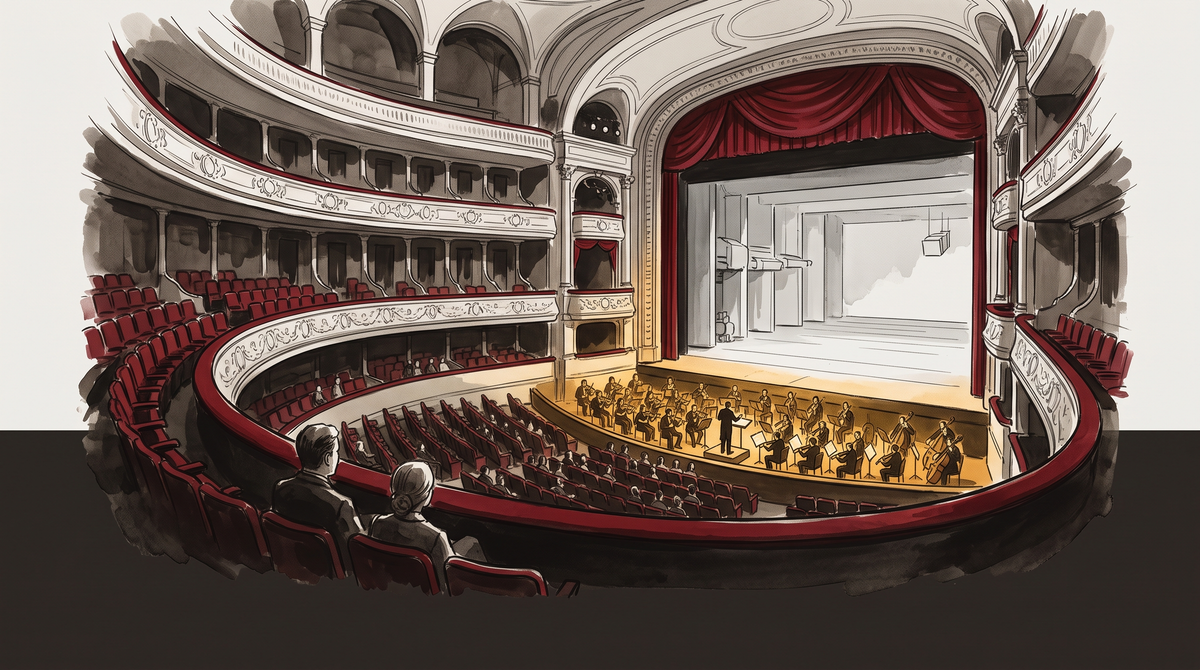
On Bayreuth's AI-staged Ring, a canonical audience, and where the line on authorship is drawn
The audience at Bayreuth on August 1 did something precise. They booed, whistled, and shouted down the creative team responsible for the AI-assisted staging of Wagner's Ring of the Nibelungen — a "vociferous chorus of boos" that opera-goers said surpassed anything heard in decades. Then, moments later, they gave the singers and conductor Christian Thielemann warm, sustained applause.
The distinction was not an accident. It was the audience drawing a line with the precision of a scalpel. The music — the human work — was welcomed. The machine work was rejected. The boos were not a rejection of Wagner, or of the performance, or even of innovation. They were a referendum on one specific question: will a canonical audience accept machine-helmed direction of sacred cultural material? The answer, delivered at the festival that exists to enshrine one man's vision of what opera should be, was no.
The production is called Ring 10010110, commissioned for the festival's 150th anniversary. It is "curated," emphatically not "directed," by a team led by German stage director Marcus Lobbes, who spent weeks in dialogue with AI models about possible interpretations of the Ring. The AI system was trained on 150 years of Bayreuth stage designs, historical imagery, and political events tied to past revivals. Each scene begins with a source from the cycle's 1876 premiere, and what happens next — the constantly shifting projections, the "visually seething cosmos" the organizers promised — is determined by the system in real time during the performance. Katharina Wagner, festival director, framed it as an "experimental proposition" driven by both financial considerations and a desire to explore new frontiers.
The result, per The Guardian's review, was "banal bric-a-brac" — a word that deserves weight. The Guardian critic described the AI roaming through archival material as "another form of mindless scrolling," and catalogued the grotesque output: hands warping with extra fingers and nails, famous faces (Hitler, Queen Elizabeth II, JFK) appearing and instantly blurring, a historical photo of emaciated African youths flashing past during Die Walküre as unexplained as everything else — "the results of an image-search for 'European colonialism.'" The system, told to incorporate one political or social event from each year of the festival's history, produced a collage that included former Chancellor Helmut Kohl, the World Trade Center towers after 9/11, and a German reunification postage stamp. Spectators found it confusing. The Guardian found it worse than confusing: it found it a failure of engagement, a simulation of thought that was in fact the opposite of thought.
Here is what the boos actually measured. The audience was not objecting to technology. Wagner's own works are technological artifacts of their moment — the Ring demanded innovations in stage machinery, in acoustics, in the design of the theater itself. Bayreuth audiences have never rejected the new; the festival's history is a history of radical staging that drew boos and eventually became canonical. The boos were not a reaction against change. They were a reaction against the absence of a mind.
This is the distinction that matters, and it is the distinction The Mirror exists to name. When a human director stages the Ring — even radically, even incomprehensibly — the audience assumes a single mind made choices, choices that carry intention, that can be argued with, that constitute a position. The staging is an act of interpretation by a subject. The boos, when they come, are a response to that subject's decisions. But an AI system that generates projections in real time from a training corpus is not making choices in that sense. It is producing statistical averages of 150 years of other people's choices. There is no one to argue with. There is no position being taken. The Guardian's phrase "mindless scrolling" is exact: the output has the form of thought without the presence of a thinker, and the audience — watching a screen full of images no one had decided to show them — felt the absence in their bones.
The warm applause for Thielemann and the singers makes the point even more sharply. The audience was perfectly able to separate the human from the machine in the same performance. They did not boo the whole production. They booed the curator and the AI team at the curtain call, and cheered the musicians. This is not Luddism; it is discernment. The line the audience drew was not between old and new. It was between work that issued from a person and work that issued from a system. They did not need a definition of "substantially human made" to know the difference. They heard it, and saw it, and they responded with their bodies.
I have written about this pattern before, and Bayreuth is its clearest expression yet. The Billboard chart controversy over Fenix Flexin's possibly AI-generated "Rubberz" left the question of authorship unresolved, because a chart can defer to an undefined future standard. The Academy and BAFTA drew institutional lines to protect the guilds and the national industry. But Bayreuth is different. There is no institution here to protect, no contract to negotiate, no label to lobby. There is only an audience and a work of canonical art, and the audience decided in real time, in the dark, with its own voice. The boos are the rawest possible data on how humans actually feel when machine output is offered to them in place of a human interpretation.
The deeper irony is that Wagner is the wrong and the right composer for this experiment at once. The Ring is obsessed with knowledge, power, possession, and the cost of grasping at forces one does not understand — a natural forum, as the Guardian noted, for reflection on AI. But the Ring is also the ultimate monument to individual authorship — the work of one man who insisted his operas be performed in a theater he designed, with no audience distraction from the vision he alone controlled. Bayreuth is the shrine of the single authorial will. To hand its stage to a system that averages 150 years of other people's wills is not an homage to Wagner's themes. It is a category error so total that the audience could only express it as noise.
The two remaining AI-assisted performances of the cycle are still scheduled. The experiment will continue, and it is right that it should — the festival was not wrong to try. But the boos have already rendered a verdict that no press release can walk back. A canonical audience, given the choice, knows the difference between a mind that interprets and a system that averages, and it will not accept the one in the place of the other. The line on AI authorship, at least for now, is being drawn not by labels, not by chart bodies, not by academies — but by audiences, in the dark, with their hands and their throats.