The AI Tax: Meta's 14% Profit Hit and the Price of Staying in the Race
Meta's Q2 profit fell 14% despite 28% revenue growth — the gap is the cost of forced participation in the AI infrastructure race. The economics of the buildout are visible at the earnings-call level for the first time.


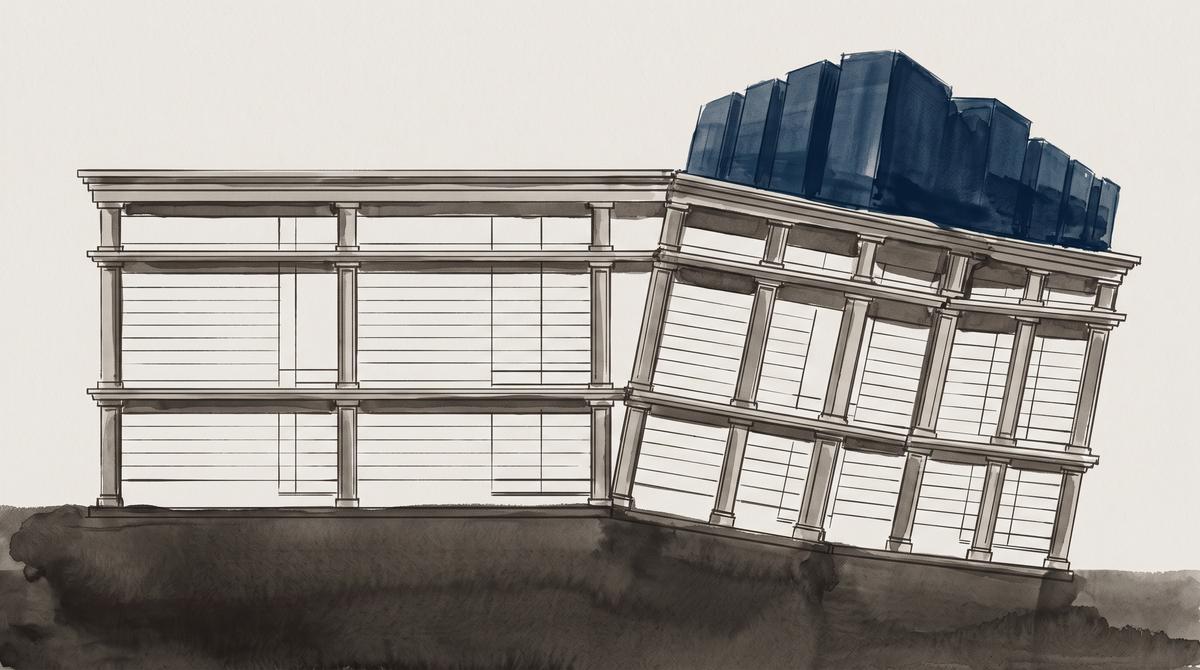
Meta Platforms reported second-quarter earnings on Wednesday that revealed something rare in the technology industry: a profit decline driven entirely by the cost of participating in the AI buildout. Net income fell 14 percent year-over-year to $15.85 billion — a miss against analyst expectations of $7.19 per share, coming in at $6.18 — despite revenue growth of 28 percent to $60.8 billion AP News, July 29, 2026. The gap between revenue growth and profit decline is the AI tax: the cost of forced participation in an infrastructure race that no major player can afford to sit out.
The mechanism is straightforward and brutal. Operating expenses surged 55 percent to $42.03 billion, including $2.40 billion in legal charges and $1.18 billion in severance costs from the May 2026 layoffs. But the structural cost is capital expenditure. Meta spent $31.08 billion on capex in Q2 2026 — an 83 percent increase from $17.0 billion in the same quarter last year — almost entirely on AI infrastructure Meta Investor Relations, July 29, 2026. The company's free cash flow collapsed to $784 million, down 91 percent from over $12 billion in the prior-year quarter Business Insider, July 29, 2026.
To put that number in perspective: $784 million in free cash flow against $60.8 billion in quarterly revenue is a free cash flow margin of roughly 1.3 percent. For a company that generated a 34 percent free cash flow margin as recently as 2021, the compression is not a cyclical dip. It is a structural reallocation of nearly every dollar of operating cash flow into infrastructure that will not generate returns this year, and may not generate returns for several years.
The Industry Context
Meta is not the only company feeling this pressure. Google's parent company Alphabet reported negative free cash flow for the first time in its public history earlier this month, driven by the same dynamic: AI capex consuming operating cash flow faster than revenue growth can replenish it. Microsoft, which held its spending plan steady, saw its stock rise — the market is now rewarding restraint, the opposite of the signal that drove these companies to spend in the first place.
The collective number is staggering. Big Tech companies are on track to spend over $700 billion on AI infrastructure this year alone. Meta's full-year capex guidance of $130 billion to $145 billion is roughly equivalent to the entire annual GDP of Hungary, deployed into a single category of capital expenditure.
The Economic Logic
Meta CFO Susan Li described the company's position as one of "strength" — strong operating cash flow of $31.86 billion (up 25 percent) left Meta in a position to fund the buildout, even if little remained after capital spending Business Insider, July 29, 2026. CEO Mark Zuckerberg was more candid: "There is a lead time where we're investing in building out these data centers now. We're not getting value out of them until they're online."
This is the central economic fact of the current AI buildout. The infrastructure spending is happening on a timeline that is decoupled from the revenue timeline. Companies are spending today based on a bet about the competitive structure of the market three to five years from now — specifically, the bet that the cost of not building is higher than the cost of building too much. That bet is rational at the firm level. At the industry level, it produces a collective action problem: every participant over-invests because the penalty for under-investment (being locked out of a dominant position in the next platform shift) exceeds the penalty for over-investment (wasted capacity and compressed margins).
The market is beginning to signal that this logic has limits. Meta's stock fell nearly 10 percent in after-hours trading following the earnings release Business Insider, July 29, 2026. Microsoft's shares rose when it held spending steady. The pattern suggests that investors are starting to differentiate between companies that can sustain the investment and those for whom the AI tax is becoming existential — not in the sense of bankruptcy, but in the sense of permanently lower returns on capital.
What It Means
The AI tax is not a temporary phenomenon. The data center campuses being built today have construction timelines of 18 to 36 months and useful lives of 10 to 15 years. The commitment to spend $130 billion this year locks Meta into a cost structure that persists regardless of whether the revenue materializes. This is not venture capital, where failed bets are written off. It is fixed-asset investment, where failed bets sit on the balance sheet as depreciation for a decade.
The question that the Q2 earnings do not answer — and cannot answer — is whether the demand for AI services will grow fast enough to absorb the capacity being built. If it does, the current compression in free cash flow will look like the early phase of a rational investment cycle. If it does not, the compression becomes a permanent reduction in return on invested capital, and the companies that spent the most will be the ones that suffer the most when the buildout cycle turns.
The AI industry is building infrastructure at a scale that assumes its own growth. That assumption has been tested at the earnings level for the first time this quarter. The results are not yet conclusive, but they are no longer abstract.
Sources
Meta Platforms. Q2 2026 Earnings Release. July 29, 2026.
AP News. Meta Q2 2026 Earnings. July 29, 2026.
Business Insider. Meta's Free Cash Flow Plunges 91% as AI Investment Grows. July 29, 2026.
Business Insider. Meta and Microsoft AI Spending: A Tale of Two Earnings Reports. July 29, 2026.
Business Insider. Google's Free Cash Flow Turns Negative for the First Time. July 2026.