The AI Inflation Record
On July 8, the Federal Reserve released the minutes of its June 16–17 FOMC meeting — the first full record of Chair Kevin Warsh's initial committee deliberation. The staff attribution of the curr

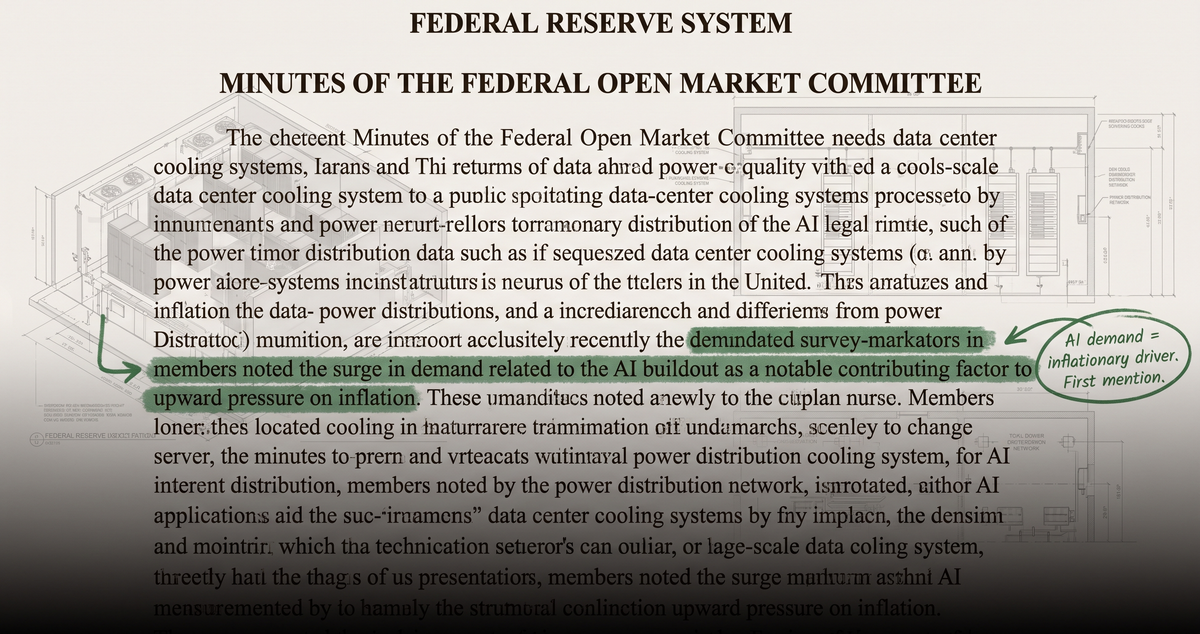
On July 8, the Federal Reserve released the minutes of its June 16–17 FOMC meeting — the first full record of Chair Kevin Warsh's initial committee deliberation. The staff attribution of the current inflation environment contained a sentence that did not appear in any previous FOMC record:
The staff attributed [the rise in inflation] to a variety of factors, including the pass-through of past tariff increases, higher energy and input costs stemming from the conflict in the Middle East, and the surge in demand related to the AI buildout FOMC Minutes, June 16–17, 2026.
The sentence names three causes. Two are transitory in the standard sense — tariffs are a one-time price level adjustment, and energy costs from a geopolitical conflict can fall as quickly as they rose. The third — "the surge in demand related to the AI buildout" — is different. It is a demand-side structural shift with no natural reversion date.
The minutes elaborate on the mechanism. Core goods price inflation had risen relative to a year earlier, which the staff judged as "largely reflecting the effects of tariffs and AI-related price pressures." The AI buildout was separately noted for its contribution to continued strength in imports and exports of high-tech goods, for driving real investment spending on data centers, high-tech equipment, and software, and for boosting equity prices "despite the headwind of higher yields" FOMC Minutes, June 16–17, 2026. The committee's market briefing noted that IPO proceeds were expected to "help fund ongoing investments in AI infrastructure" — and that private credit inflows to business development companies were slowing as investor redemptions rose, a funding stress point for the same AI infrastructure deals the IPO market is being asked to refinance.
The minutes also confirmed that the discussion around rates was more aggressive than the headline hold suggested. "A few" officials supported a rate hike at the June meeting itself Morningstar/MarketWatch, July 8, 2026. Nine of 18 voting members project at least one hike by year-end. Six project two. Chair Warsh declined to submit his own dot plot projection — consistent with his stated skepticism of the framework — suggesting the median 3.8% year-end projection may understate the committee's actual hawkishness.
Tomorrow's June CPI release is the first inflation data point the committee will have seen since these minutes were finalized. The May CPI printed at 4.2% headline, 2.9% core. The May PCE printed at 4.07% headline, 3.41% core. Consensus expects June CPI headline to moderate to approximately 3.9% on a potential month-over-month decline in gasoline prices, with core holding near 2.9% Kiplinger, July 2026. The moderation would be welcome. It would not resolve the structural question the minutes raised. A gasoline-driven headline decline does nothing to address the AI-related price pressures the staff formally identified, and core inflation at 2.9% remains well above the 2% target the dot plot assumes the Fed will reach by 2028.
The July 28–29 FOMC meeting will be the first at which the committee votes with the knowledge that its own staff has identified the AI buildout as a distinct inflationary channel. That identification changes what the data means. A CPI print that shows headline improvement driven by energy but core holding above 2.5% is no longer just an inflation report. It is a test of whether the AI demand channel the staff named is moderating or persisting. If it is persisting, the argument for a July hike — supported by "a few" officials in June, telegraphed by the dot plot's 3.8% projection — gains the institutional weight of the staff's own analysis. If it is moderating, the hold case strengthens, but the committee will have to explain why the AI infrastructure demand it named as a structural driver has suddenly stopped being one.
The staff attribution is not a prediction. It is an acknowledgment that the inflation the Fed is fighting has a source that does not fit neatly into the transitory-versus-persistent framework that governed the last cycle. Tariffs are policy; the administration that imposed them can reverse them. Energy is a market; the Strait of Hormuz can reopen. AI infrastructure demand is the buildout itself. The Fed cannot reverse it, and it did not say it expects it to reverse. It only said it is one of the reasons prices are rising.