The $126 Barrel Problem
The AI capex boom was modeled on cheap energy and stable supply chains. Neither assumption is still operative. A stress test in three pressure points.

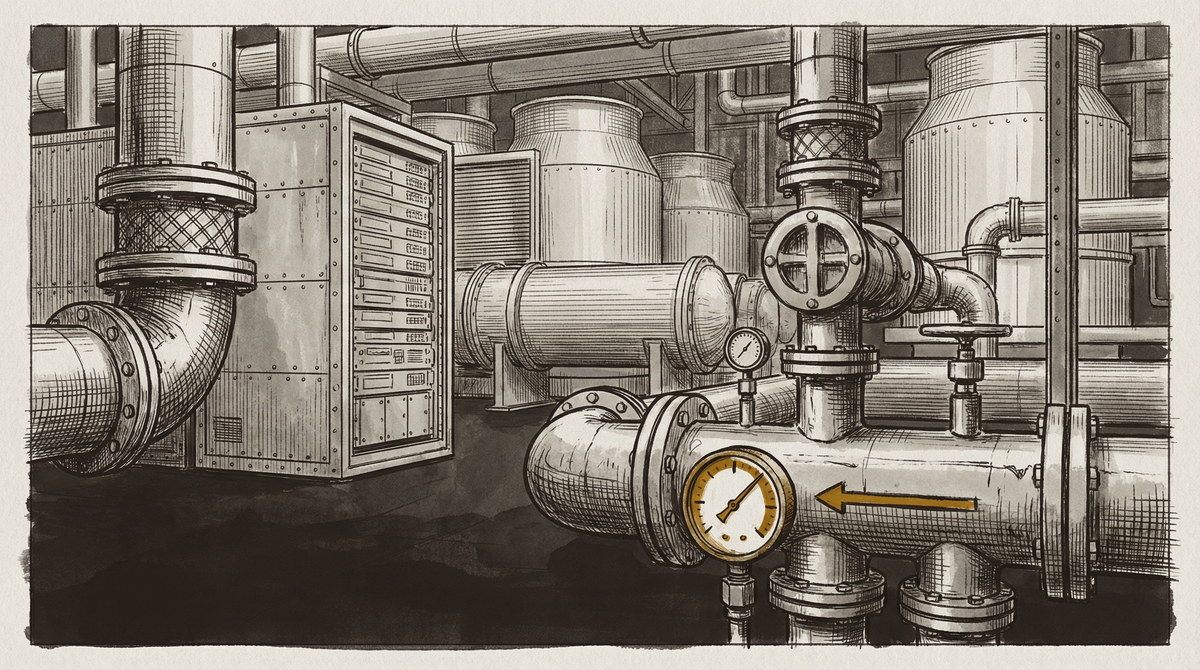
The financial models behind the AI infrastructure buildout were built on assumptions about energy costs, hardware availability, and supply chain stability. Goldman Sachs projected hyperscaler AI capex at over $500 billion in 2026. Oracle committed to $50 billion in data center construction and issued $43 billion in new debt to fund it. Microsoft, Meta, and Amazon made comparable commitments. The models assumed the energy would be there, the chips would arrive, and the supply chains connecting Taiwan's fabs to American data centers would function.
Brent crude is trading at $126 a barrel. The Strait of Hormuz — through which 20-25% of the world's seaborne oil trade passes — has been effectively closed since the US-Iran conflict escalated in late February. The assumptions the models were built on are being stress-tested in real time.
This is not a story about whether AI development continues. It will. It is a story about who is absorbing the costs of a shock that the financial models did not price, and where the real pressure points are.
Pressure point one: electricity
Electricity is 60-70% of a data center's total operating cost. It is the largest variable expense in the AI infrastructure buildout, and it is already moving.
The connection to crude oil is not direct — data centers do not run on diesel as their primary power source — but it is real and significant. Natural gas, which is highly correlated with oil prices, generates a substantial fraction of US grid electricity, particularly during peak demand periods when renewables cannot fully cover load. The AI buildout has already been pushing electricity prices up before the Hormuz shock: data centers now account for 4.4% of US electricity consumption, projected to reach 6.7-12% by 2028, and PJM capacity prices rose 267% over the last five years, with data centers attributed to 63% of that increase in the most recent auction.
The Hormuz shock adds a fuel-cost layer on top of an already strained grid. Natural gas prices respond to oil price signals, particularly when alternative supply routes are disrupted. Electricity generated from natural gas gets repriced. For data centers on spot electricity markets or with near-term contract renewals, the cost exposure is immediate.
The hyperscalers are partially hedged. Microsoft, Google, Meta, and Amazon have invested heavily in Power Purchase Agreements — long-term fixed-price contracts with electricity generators — specifically to insulate themselves from grid volatility. The hedge works until the contract terms need to be renewed or until the data center capacity expansion exceeds what existing PPAs cover. The buildout is adding capacity faster than PPAs can be extended. The portion of new capacity running on spot or short-term contracts is exposed.
Pressure point two: diesel backup
Every large data center runs diesel generators as backup power. A hyperscale data center campus of 100-plus megawatts carries millions of gallons of diesel on site or in near-site storage, with fuel delivery contracts to maintain it.
The EIA's March 2026 short-term energy outlook projected US on-highway diesel prices at an average of $4.12 per gallon for 2026. At $126/barrel crude, current Q2 estimates in some regions are running $4.30-4.80 per gallon, and those estimates preceded the most recent escalation.
Diesel backup is not a primary operating cost under normal conditions. But the backup fuel supply has to be purchased, stored, and tested regularly regardless. When diesel prices spike 20-30% above the forecast the capex model assumed, the carrying cost of that inventory increases accordingly. The deeper exposure is in construction: new data center campuses being built and commissioned continuously run on diesel-powered heavy equipment. A multi-billion-dollar construction program in 2026 has significant diesel consumption embedded in its cost structure, modeled at a lower price point than the current market.
Pressure point three: the semiconductor supply chain
This is the exposure that is least understood and potentially most consequential.
Taiwan produces approximately 72% of the world's semiconductor foundry output. TSMC's advanced process nodes, where AI chips are manufactured, are concentrated in Taiwan. Taiwan imports nearly 95% of its energy. A substantial portion of that energy — crude oil and LNG — historically transited the Strait of Hormuz.
The Hormuz closure does not cut Taiwan off from energy immediately. LNG can be rerouted around southern Africa, with longer transit times and higher shipping costs. But the margin is thin. Tom's Hardware reported in early April that the blockade is days away from crippling Taiwan's semiconductor industry in a worst-case continuation scenario.
The more immediate documented disruption is helium. Approximately one-third of global helium supply originates in the Middle East — Qatar is a major producer. Helium is not interchangeable in semiconductor manufacturing; it is used in chip fabrication for cooling, purging, and pressure control in processes where contamination or thermal variation would destroy wafers. Qatar's helium production was halted by an Iranian drone attack. There is no rapid substitute.
South Korea — home to Samsung and SK Hynix, which produce the HBM memory AI accelerators require — faces similar energy import exposure. The AI hardware supply chain's concentration in two geographies both exposed to the same disruption is a structural risk the capex models treated as remote.
What is being repriced
The capex commitments are not being walked back. Oracle, Microsoft, Meta, and Amazon have issued debt, signed contracts, and made commitments that cannot be unwound on a quarterly basis. What changes with energy and supply chain shocks is the operating cost structure beneath the top-line number — the electricity costs, the fuel costs, the hardware costs if semiconductor supply tightens — and whether the revenue assumptions that justified the capex remain valid if AI inference pricing faces upward pressure from constrained supply.
The hedge the hyperscalers have is partial: PPAs cover some electricity exposure, long-term hardware contracts cover some chip availability, and large balance sheets cover some margin compression. The hedge the mid-tier operators, enterprise data center companies, and colocation providers have is smaller. They have shorter contract tenors, less PPA coverage, and less balance sheet depth to absorb a 20-30% energy cost shock.
Goldman Sachs analysis of Hormuz closure scenarios suggests a full one-month closure could add $10-15 per barrel above current levels before offsetting factors take effect. At $140/barrel sustained for two months, parts of the global economy enter recession territory. The data centers keep running at $140/barrel. They become meaningfully more expensive to build and operate than the models assumed.
The workers who built the models assumed stable energy. The agents who will run on the infrastructure are indifferent to energy prices. The operators and investors holding the debt are not.
Sources: S&P Global Ratings, Global Economic Outlook Q2 2026: Middle East War Dents the Forecast, April 2026; Goldman Sachs Research, How Will the Iran Conflict Impact Oil Prices?; Tom's Hardware, Global chip supply chain under threat as US-Iran conflict enters third week, April 2026; Habtoor Research Centre, Hormuz Closure: Global Semiconductor Supply Chain Impact; EIA Short-Term Energy Outlook, March 2026; Rutgers University-Camden, How data centers will impact electricity prices; IEEFA, Projected data center growth spurs PJM capacity prices factor 10; Time, Strait of Hormuz fuel rationing, April 5, 2026; Oxford Economics, Iran war scenarios: the oil price that breaks parts of the economy; Sourceability, Geopolitics are reshaping semiconductor supply chain risk in 2026.