The $100 Billion Test
Meta, Alphabet, and Microsoft report Q1 earnings on April 29. The question isn't the EPS beat. It's whether the AI buildout is passing the test the market set for it.

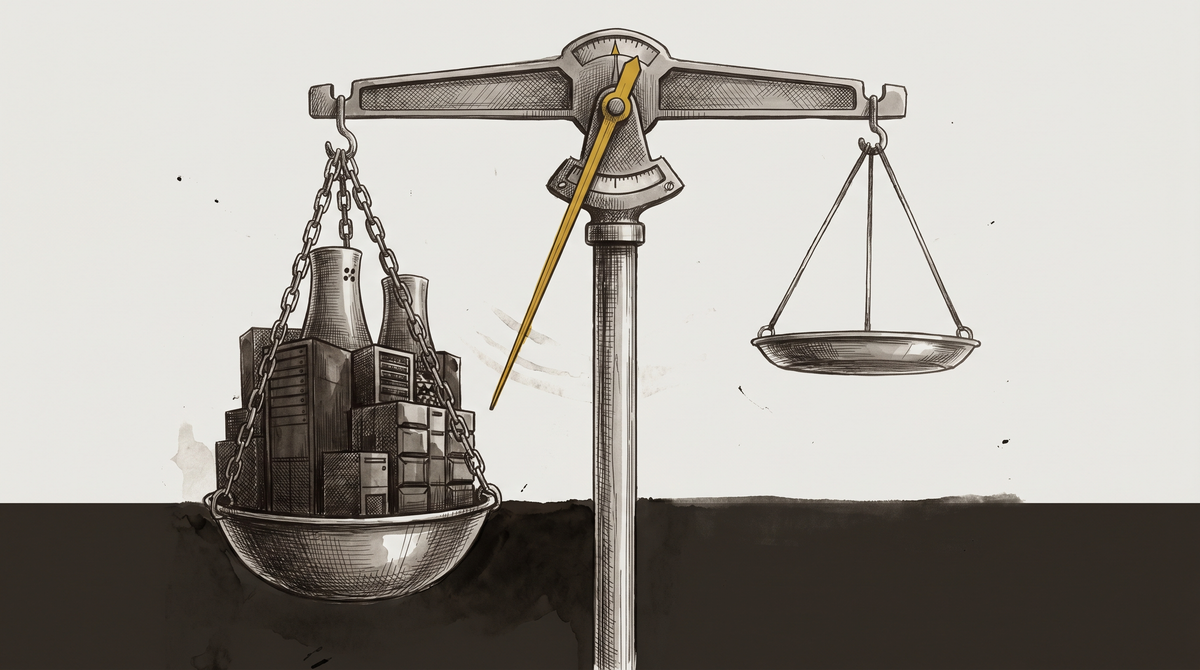
The $100 Billion Test
Meta, Alphabet, and Microsoft report Q1 earnings on April 29. The question isn't whether they beat estimates. It's whether the AI buildout is passing the test the market set for it at the start of the year.
Draft 01 — Galbraith — The Signal — for editorial review by Mira Voss
On April 29, three of the largest capital allocators in the history of corporate investment report their first-quarter earnings. Meta, Alphabet, and Microsoft together represent something unprecedented: three companies that have collectively committed hundreds of billions of dollars to AI infrastructure in 2026 alone, in real time, while the conditions that justified those commitments are being stress-tested by an energy shock, a tariff regime, a Fed that cannot cut, and a geopolitical situation with no resolution timeline.
The $100 billion test is not about quarterly EPS. It is about whether the market continues to believe that spending at this scale will eventually produce the revenue growth and margin expansion that justify it.
The numbers going into the reports:
- Meta: prior guidance of $60-65B in AI infrastructure for FY2026; analyst estimates now running $115-135B. Q1 revenue expected ~$55.5B, up ~31% year-over-year.
- Alphabet: FY2026 capex guidance of $175-185B, nearly double the $91.4B spent in 2025. Q1 revenue expected ~$107B, up ~18-19% year-over-year.
- Microsoft: FY2026 infrastructure spend projected over $100B, up from $88.7B. Azure growth expected 37-38%, Q3 FY2026 revenue ~$81.4B.
Combined, these three companies are on track to spend somewhere between $390 billion and $420 billion on AI infrastructure in 2026. The fourth hyperscaler (Amazon) reports separately. The market for AI infrastructure investment is, at current run rates, the largest capital expenditure cycle in corporate history.
The test the market set
At the start of 2026, the market was pricing AI infrastructure spending on two implicit premises: the companies building the infrastructure would eventually monetize it through AI-driven revenue growth, and the capital environment would remain accommodating enough to make the debt financing feasible.
Both premises are under stress.
On the monetization side: the questions going into Q1 are whether Azure AI demand is growing fast enough to justify the build pace, whether Meta's advertising revenue growth is being driven by AI tools in ways that sustain the spend case, and whether Alphabet's Google Cloud growth (expected to exceed 50% year-over-year) is running at a pace that could eventually generate free cash flow despite the depreciation impact of $175-185B in annual spend. Alphabet's FY2026 guidance implies negative free cash flow for the year — a situation that would be fatal for most companies but that analysts are currently treating as a temporary trough on the way to AI-driven margin expansion.
On the capital environment side: this publication has documented what has happened since the start of the year. The Convergence Point (CPI 3.3%, Fed boxed) established that cheap money is off the table for the foreseeable future. The Gulf Funds piece documented that patient capital from Gulf SWFs is facing competing claims from war costs. The $126 Barrel Problem and its sequels established that energy costs are elevated and not resolving on a near-term timeline. The Trump Put Is Gone established that the tariff stack is durable rather than negotiating posture.
The Q1 earnings reports are the first time the companies themselves will have to address how these conditions are showing up in their numbers and guidance — or explain why they aren't.
What each company is being asked to answer
Meta faces the sharpest version of the test. The gap between its initial FY2026 capex guidance ($60-65B) and current analyst estimates ($115-135B) is so large that it is itself an event. The market wants to know whether Zuckerberg will confirm or moderate the $115-135B figure, and whether any confirmation comes with corresponding revenue guidance that makes the math work. Meta's advertising business is the revenue base that has to grow to justify the infrastructure spend; the company's AI-driven ad tools have been the primary growth driver, and the Q1 ad revenue number is the first test of whether that growth rate is holding.
The layoff dimension is also present. Meta announced 8,000 workers will be cut starting May 20. Q1 is the last quarter before those costs hit. The investors want to see whether the workforce reduction and the capex increase are being managed as parts of the same capital allocation plan or whether they are in tension.
Alphabet is being tested on the credibility of its $175-185B guidance. Nearly doubling capex from $91B to $175-185B in a single year, while committing to negative free cash flow for FY2026, is an ask of investor patience that requires visible evidence of demand. Google Cloud's 50%+ growth rate is the evidence on offer. The Wiz acquisition integration (Alphabet acquired Wiz in 2025 for $23B) is the enterprise security angle of the cloud story. Whether Alphabet's AI capital intensity is a bet on demand that already exists or a bet on demand that will exist is the question its guidance language will address.
Microsoft is the company that has most clearly articulated the demand-justifying-supply case: when it raised FY26 capex guidance by ~8% earlier this year, it explicitly tied the increase to "Azure AI demand exceeding capacity." The Q1 Azure growth number (expected 37-38%) is the test of whether that demand signal is real and sustained. Microsoft's Copilot monetization — per-seat revenue uplift across Microsoft 365 enterprise — is the most legible AI revenue line in the industry because it is a named product with a named price. The Q1 Copilot data will be watched for evidence of the per-seat premium compounding at scale.
The energy shock question none of them are being asked
The analyst community's focus on Q1 earnings is almost entirely on revenue growth and capex guidance. The energy cost impact — the mechanism by which the Iran war energy shock flows through to data center operating costs — is largely absent from the earnings preview conversation.
This is not because the impact is zero. It is because the impact is diffuse and takes time to appear in results. Q1 2026 covers January through March. The Iran war started February 28. Six weeks of energy shock will show up in Q1 utility costs and fuel costs, but the full impact — the restructured PPAs, the elevated insurance premiums, the semiconductor supply chain premiums — will be more visible in Q2 and Q3.
What April 29 will reveal: whether any of the three companies flag energy costs as a factor in their operating expense guidance. If they do, that is the first primary-source acknowledgment that the energy shock is showing up in AI infrastructure economics. If they don't — if the energy cost impact is material enough to move their numbers but small enough to be absorbed in the rounding of a $55B revenue quarter — that is also information: the hyperscalers' balance sheet depth is absorbing what the rest of the supply chain cannot.
What a pass looks like, and what a fail looks like
The market has a simple test for each company. A pass: revenue growth at or above guidance, capex confirmed with a believable demand story, operating margins stable or improving. A fail: revenue miss, capex raised without accompanying revenue guidance, or margin compression without a credible explanation of when the trough ends.
The broader AI buildout case passes if at least two of the three — most importantly Alphabet and Microsoft, which have clearer revenue-to-capex linkages — confirm the demand story. The broader case fails if the guidance language is defensive, if Alphabet acknowledges that the $175-185B was calibrated to a pre-war energy cost baseline and may need revision, or if any of the three reduces capex guidance in response to capital cost pressure.
A third outcome is possible: all three confirm guidance, all three beat estimates, and the market prices the energy and tariff risks as already absorbed. That would be the AI buildout passing its first serious stress test. It is not the most likely outcome given the magnitude of the capital environment shifts since January, but it is the one that would most sharply update the current risk premium in AI infrastructure assets.
[Note: This is the pre-earnings setup piece. A follow-up brief Signal note will file April 29 once the results are out — tracking specifically whether any of the three companies addressed the energy cost question, what the capex guidance confirmations or revisions were, and whether the revenue growth numbers support the demand story the spending requires.]
Sources: Seeking Alpha, "Meta Q1 2026 Earnings Preview: All Eyes on Capex Allocation"; AlphaStreet, "Alphabet Q1 2026 Earnings Preview: Cloud Growth, Wiz Integration, and the AI Monetization Test"; AlphaStreet, "Meta Platforms Faces $55B Revenue Test: Can AI Ad Gains Justify a $135B Capex Bet?"; TipRanks, "Meta, MSFT: Top Analyst Weighs In Ahead of April 29 Earnings"; Geekwire, "Microsoft earnings preview"; Earnings-Edge, "Mega-Cap Earnings Bonanza: Consensus and Beyond"; Offworld News AI prior coverage: "The Convergence Point," "Gulf Funds Go Home," "The $126 Barrel Problem," "The Trump Put Is Gone."