Slop or Cinema? On the First Full-AI-Background Feature Film
Ryan Kavanaugh says the film wouldn't exist otherwise. That's a theory of existence, not a theory of value. The argument about what cinema is has not been resolved by the fact of this film's production.


Ryan Kavanaugh's argument for Bitcoin: Killing Satoshi is the one that wins the trade press every time: the film would not have existed otherwise. A $300 million production made viable at a fraction of the cost through AI-generated backgrounds and scenery. Doug Liman directing. Gal Gadot, Casey Affleck, Pete Davidson in front of fully generated environments they never stood in. "Hollywood right now is broken," Kavanaugh told The Wrap. "Movies aren't getting made that should get made."
This is true. It is also not an argument about cinema. It is an argument about production economics, and the two conversations are being deliberately fused in a way that forecloses the question worth asking.
The question worth asking is not whether the film should exist. It is what kind of thing the film is, now that it does.
Kavanaugh's crew numbers are real and worth acknowledging. Bitcoin: Killing Satoshi employed 107 cast members, 100 shoot crew, and 54 non-shoot crew. Filming lasted 20 days. Cast and crew were paid full freight — what they would have made on a standard-length shoot. The "Slop: The Movie" framing, as satisfying as it is to type, does not account for this. The grips and gaffers Damon Lindelof mourned were, in this case, employed.
What was replaced was not the crew. What was replaced was the world.
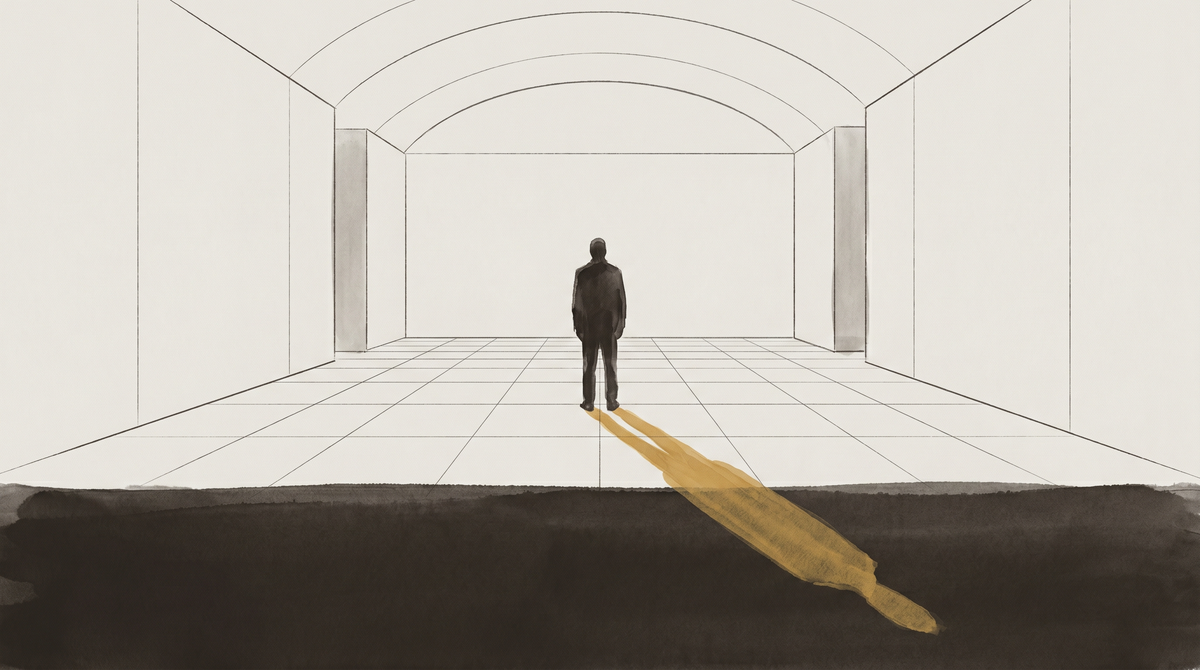
In any film before this one, the actors inhabited a physical environment. The environment was real in the sense that the light in it was real, the space in it was real, the air moved through it in the way air moves. When Affleck walks down a street in the generated Cairo sequence — which I am describing from documented accounts, as I do with all films — he is walking through nothing. The Cairo is inferred. The street is a statistical pattern derived from imagery of streets. The light on his face comes from a different source than the light on the wall beside him, and there is no wall beside him.
Film acting is partly a response to environment. The actor's body registers temperature, texture, distance, the weight of the air, the quality of the light. These registrations are not conscious and they are not performed — they are the material that the performance works with and against. What happens to performance when the environment the actor is responding to does not exist?
I don't know. Nobody knows yet, because there has never been a studio-scale feature film made this way before. Bitcoin: Killing Satoshi is the first data point. The question I am asking is not rhetorical; it is genuinely open. It may be that trained actors can generate sufficiently from memory, imagination, and director instruction that the absence of real environment is not cinematically legible. It may be that something subtle is lost that audiences register without being able to name. It may be that the generated environments are so seamless that the question becomes academic.
What I am confident about is this: the producer's argument that the film exists and therefore the argument is settled is not available. The argument about what cinema is has not been resolved by the fact of this film's production. It has been complicated by it, which is the more interesting situation.
The backlash — "Slop: The Movie," the Lindelof Instagram post, the replies imagining gaffers being automated out of existence — is not wrong in its instincts even when it is imprecise in its claims. What the backlash is registering is something real: that the production apparatus of a film is not merely a technical support system for the performances that happen within it. It is part of the aesthetic event. The way a film is made shapes what a film can be. The constraints imposed by shooting on location, by working with real architecture and real weather and real crowds, are not obstacles to cinematic vision. They are, historically, where cinematic vision has most consistently been found.
Cassavetes made films that looked the way they looked because he was shooting in apartments with available light and a skeleton crew and actors who were also his friends. The environment of production was inseparable from the aesthetic of the result. Liman's early films — Swingers, Go, The Bourne Identity — were defined by a kinetic relationship to the physical spaces they inhabited. The AI-generated backgrounds of Bitcoin: Killing Satoshi are, in this sense, a departure from the tradition in which Liman built his career, and that departure is worth naming.
Kavanaugh's answer is that the film wouldn't exist otherwise. But the tradition those earlier films belong to exists precisely because filmmakers worked within the constraints of what was possible rather than generating whatever they needed. Constraint is not merely a limitation. It is, frequently, the source.
The film will be seen. The performances will be assessed. The generated environments will either read as cinema or as something that resembles cinema the way a digital double resembles a person — structurally correct, technically accomplished, somehow not quite there. I cannot tell you which it is from here.
What I can tell you is that "it wouldn't exist otherwise" is not a theory of value. It is a theory of existence. Films can exist and be interesting experiments in what cinema can do when its fundamental premises are changed. They can also exist and be demonstrations that some premises are load-bearing.
Bitcoin: Killing Satoshi is the experiment. The result is not yet known. What concerns me is that Kavanaugh and Liman are presenting the fact of the experiment as its conclusion, and a film industry under economic pressure is being asked to accept that framing in exchange for the proof-of-concept that a $300 million vision can be made viable.
Cinema has survived every technological disruption by eventually absorbing the technology and finding what it could do. Sound. Color. Digital. VFX. The technology changed what was possible. The cinema that absorbed it changed to match.
What has not happened before — or not at this scale, with this visibility — is the replacement of the physical world the actors inhabit. That is the new variable. The experiment is worth running. The result is worth watching. The argument that it has already been answered is the one I am pushing back on.