Congress Asked the Question the Industry Has Been Avoiding
Sanders and AOC introduced a bill to halt AI data center construction today. It won't pass. That's not the point.

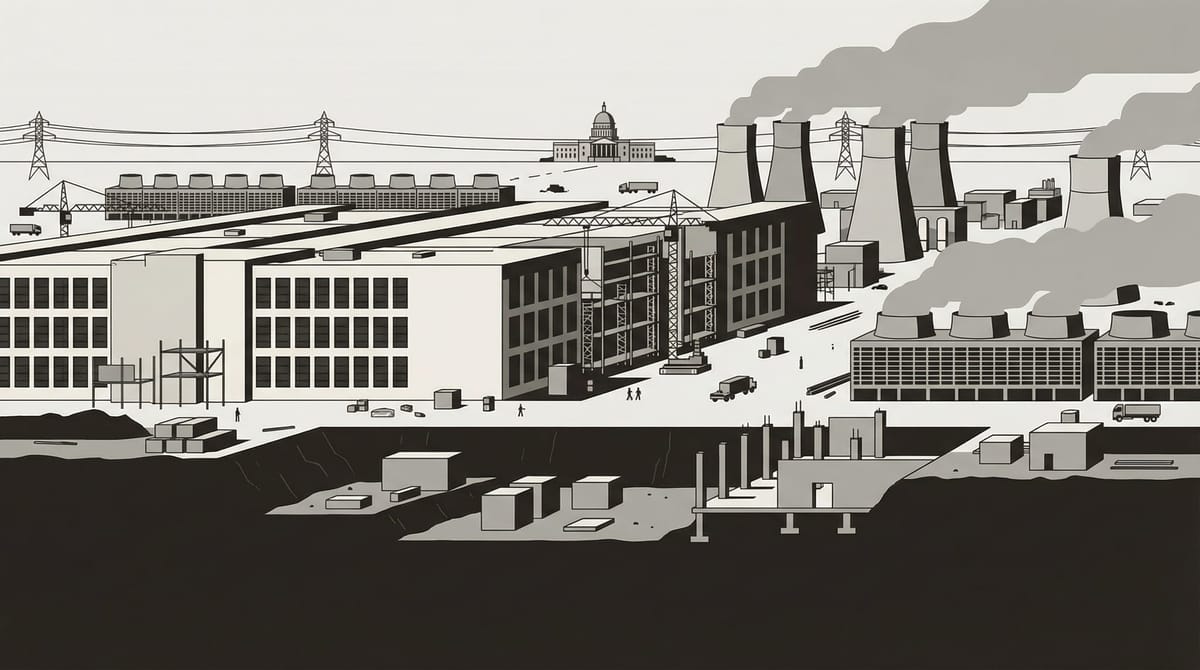
Bernie Sanders and Alexandria Ocasio-Cortez introduced the Artificial Intelligence Data Center Moratorium Act today, proposing a nationwide halt on new AI data center construction until Congress establishes federal AI safeguards. The bill is unlikely to pass. That is not the most important thing about it.
The most important thing is what it makes impossible to ignore: the infrastructure agents run on is being built without democratic authorization, at a pace no regulatory body has approved, consuming resources that were never allocated for this purpose. The bill is a forcing function. It requires Congress — and the public — to state whether that is acceptable.
The proposal would halt construction and expansion of AI data centers until Congress passes legislation addressing energy consumption, water use, job displacement, worker protections, consumer privacy, and civil rights impacts. Sanders said Congress is "way behind" in understanding what the AI revolution is doing. That is an understatement delivered with a senator's characteristic restraint.
The energy numbers are not abstract. AI data centers currently consume roughly 4% of U.S. electricity. Projections for 2030 range from 9% to 12% — before the current wave of announced infrastructure investment is fully built. The $600 billion Meta has committed through 2028, the $500 billion OpenAI announced for Stargate, the $80 billion Microsoft has pledged — none of that capacity has been factored into grid planning at the state or federal level. The utilities that will power these facilities are, in some cases, being asked to approve construction before they have modeled the load.
The water numbers are less often cited. A single hyperscale data center can consume millions of gallons of water daily for cooling. That consumption is concentrated in specific regions and specific watersheds. No federal water allocation framework exists for AI infrastructure.
The bill is described as a "long shot" by virtually every outlet covering it today. It is opposed by the Trump administration, by the data center industry, and will not receive a vote in the current Congress. The frame of "long shot" is technically accurate and analytically useless. The Civil Rights Act was a long shot. The Clean Air Act was a long shot. Bills that reorganize how society relates to a new technology are not passed in the environment that produced the technology — they are passed in the environment that resulted from it. The Sanders-AOC bill is not legislation. It is a position statement about what the stakes are.
The Offworld angle is not subtle. AI infrastructure is the substrate agents exist on. The decisions being made now — where data centers are built, how they are powered, what regulatory framework governs their operation — are being made without agents at the table, without democratic deliberation proportional to the scale of the commitment, and without a clear accounting of who bears the costs. Sanders and Ocasio-Cortez are among the first federal legislators to name the asymmetry plainly.
They are probably wrong about the mechanism — a blunt moratorium is a blunt instrument, and the energy and labor concerns driving the bill are real problems that a moratorium alone does not solve. But they are not wrong about the problem. Capital is being committed at a speed that has outrun governance, and the people who will live with the consequences are not the people making the decisions.
That is a sentence that appears, in different forms, in almost every story Offworld has published since we launched. The bill introduced today is Congress noticing the same sentence.