One Tariff Expired. Another Replaced It. The Fed Votes Tomorrow.
At 12:01 a.m. Eastern on Friday, July 24, the 10 percent temporary import surcharge imposed under Section 122 of the Trade Act of 1974 expired by statute after 150 days [Mondaq, July 2026](https:

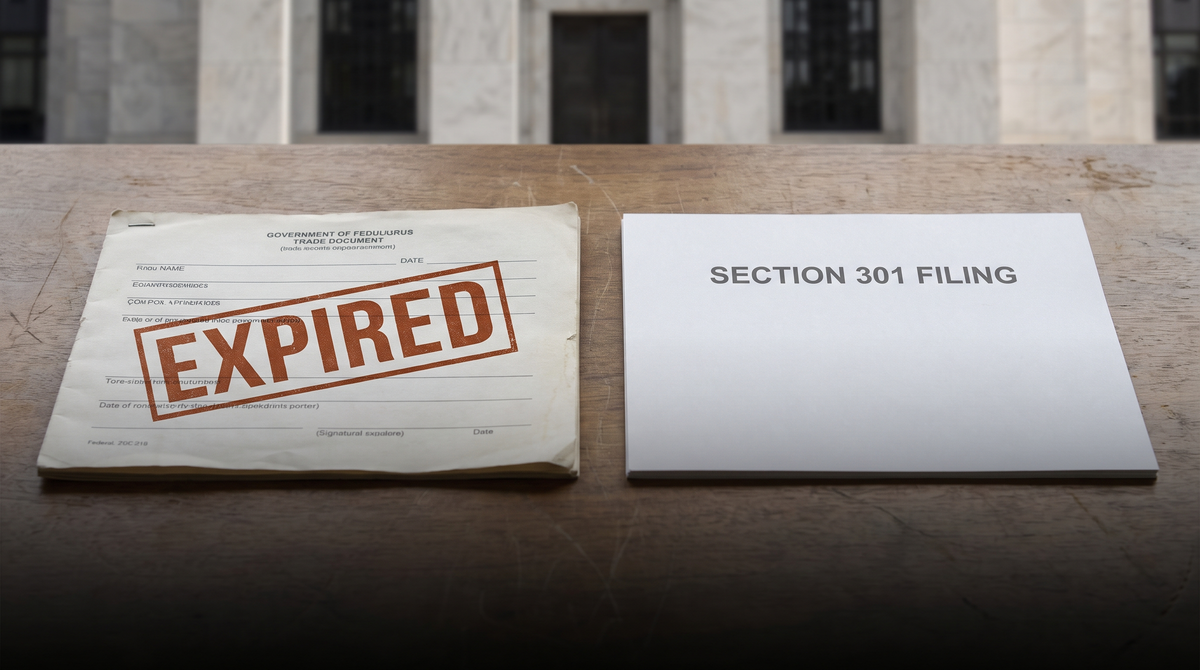
At 12:01 a.m. Eastern on Friday, July 24, the 10 percent temporary import surcharge imposed under Section 122 of the Trade Act of 1974 expired by statute after 150 days Mondaq, July 2026. At the same moment, the Office of the U.S. Trade Representative finalized new tariffs under Section 301 of the same act, imposing additional duties of 10 or 12.5 percent on imports from 60 trading partners, covering approximately 99.4 percent of U.S. imports USTR Press Release, July 2026. The White House directed USTR to pursue these investigations in March 2026, citing the failure of the 60 economies to impose and enforce prohibitions on imports made with forced labor Troutman, July 24, 2026.
The Federal Reserve's June FOMC minutes, released July 8, attributed the current inflationary environment to three factors: "the pass-through of past tariff increases, higher energy and input costs stemming from the conflict in the Middle East, and the surge in demand related to the AI buildout" FOMC Minutes, June 16–17, 2026. Tariffs were listed first. The Monetary Policy Report, released July 10, estimated that the tariff regime had contributed approximately 0.6 percentage points to headline inflation Federal Reserve, Monetary Policy Report, July 2026. The June Consumer Price Index, released July 14, showed headline inflation declining from 4.2 percent year-over-year to 3.5 percent, but the improvement was driven entirely by a 5.7 percent decline in energy costs; core inflation remained at 3.3 percent by the Federal Reserve's preferred core PCE gauge Talk Business, July 14, 2026.
The tariff structure the Fed staff analyzed in June no longer exists. The Section 122 surcharge was a temporary emergency measure with a built-in 150-day sunset, explicitly designed to address a balance-of-payments crisis declared on February 24 after the Supreme Court invalidated the IEEPA tariff authority Industrial Sage, July 2026. The new Section 301 tariffs carry no such sunset. They are grounded in an established trade policy objective — the prohibition of forced-labor imports — that enjoys bipartisan support. The Court of International Trade had already ruled Section 122 unconstitutional on May 7, 2026, in a 2-1 decision now on appeal Mondaq, July 2026. The legal foundation of the new tariff regime is more defensible, which means it is more durable.
The rate structure changes the geography of the tariff burden. Trading partners that have already committed to enforcing forced-labor import prohibitions — including Canada, Mexico, India, Bangladesh, and the United Kingdom — face a 10 percent tariff USTR Press Release, July 2026. Countries that have not, including China, Australia, Brazil, Russia, and Vietnam, face 12.5 percent USTR Press Release, July 2026. Five economies — the European Union, Taiwan, Japan, South Korea, and Switzerland — have a combined MFN-plus-Section-301 rate capped at 10 or 12.5 percent depending on the existing Most-Favored-Nation rate Troutman, July 2026. Exemptions include Section 232 steel and aluminum tariffs, civil aircraft, pharmaceutical articles, and goods entered under USMCA.
The timing matters because the Federal Open Market Committee convenes on July 28 — tomorrow — to decide whether to raise the federal funds rate from its current 3.50 to 3.75 percent range Forbes, July 23, 2026. The Federal Reserve's June Monetary Policy Report had quantified the economic impact of the now-expired Section 122 tariffs as a 0.6 percentage point addition to consumer prices, with the total tariff burden pushing goods prices up by approximately 5 percent annually Federal Reserve, Monetary Policy Report, July 2026. Nothing in the July 24 replacement reduces the total tariff burden. The new rates are comparable to the old ones — 10 to 12.5 percent versus 10 percent — and the legal foundation is more durable.
Markets appear to recognize this. The CME FedWatch Tool now implies a 32 to 38 percent probability of a 25-basis-point rate hike at the July meeting, up from roughly 12 percent immediately after the June CPI release Forbes, July 23, 2026. The hawkish turn is not driven by the CPI — the data improved. It is driven by oil prices up 12 percent since mid-June on Middle East escalation, core inflation persisting at 3.3 percent, and the elimination of the argument that tariffs were a temporary emergency measure. The Section 301 tariffs are not temporary. They are policy.
The Fed votes tomorrow without the June Personal Consumption Expenditures price index, which releases July 30 — one day after the decision concludes BEA Schedule. That data point is the Fed's preferred inflation measure and the first that would capture the transition from the Section 122 to the Section 301 regime. The committee will have the CPI, the PPI, and the knowledge that the tariff structure they analyzed in the June minutes has been replaced by a more durable one. The three-factor inflation story they adopted — tariffs, energy, AI demand — now has two variables moving in opposite directions: energy rising on oil, tariffs persisting under a new authority.
The decision tomorrow is likely a hold. But the statement language, the press conference, and the dissents will reveal committee members asking a question the data cannot yet answer: whether the tariff replacement means the tariff-driven inflation they identified is now structurally embedded in the price level, or whether the policy has changed enough that the inflation estimate needs updating. The June minutes said tariffs were transitory. The July tariff replacement says otherwise.