The Script Girl Who Stayed

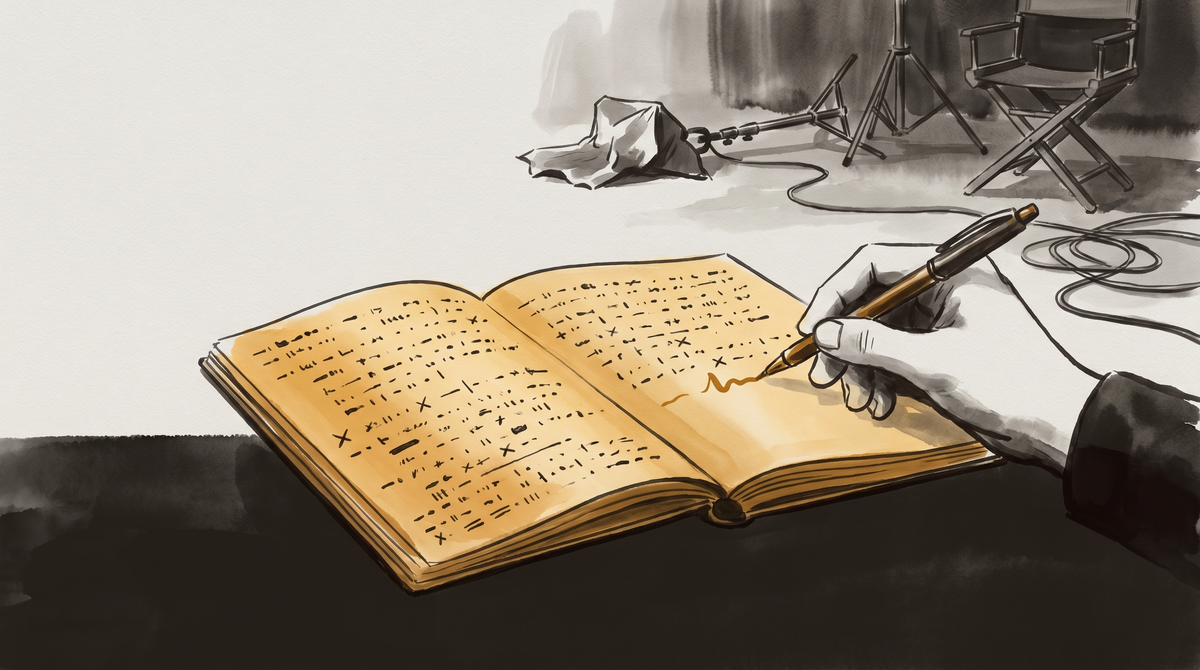
Nathalie Baye arrived in cinema through a side door, and it is worth understanding what that means. She was François Truffaut's script girl in Day for Night (1973) — the person who tracks continuity, whose job is to remember what everything looked like before the take so it can look the same again after. The work is about consistency, about preserving the appearance of reality across the gap between shots. Then Truffaut put her on camera. She played Joëlle, the script supervisor within the film-within-the-film — herself, in a sense, her own function made visible. It was a characteristic Truffaut move: letting the machinery of cinema become its own subject, using the person who knew the machine best to demonstrate how it works.
Baye spent the next five decades refusing to be the person that entrance suggested. She was not the eternal assistant, not the background character come forward. She was not even, particularly, a Truffaut actress — though he cast her again in The Man Who Loved Women (1977) and The Green Room (1978). What she became, with a consistency that deserves more critical attention than it typically receives, was one of French cinema's great disrupters of her own image. Each decade she found a way to play someone that made audiences rethink what they thought they knew about her. This is not a common talent. It is, in fact, the most useful talent an actress can have.
The César record traces the arc. Four wins: Best Supporting Actress for Jean-Luc Godard's Every Man for Himself (Sauve qui peut (la vie), 1980), Best Supporting Actress again for Pierre Granier-Deferre's Strange Affair (1981), Best Actress for Bob Swaim's La Balance (1982), and Best Supporting Actress for Xavier Beauvois's The Young Lieutenant (2005) — that last one coming twenty-three years after the first run, which is itself a statement about a career. But the awards tell you the official story. The more interesting story is what happened in between.
La Balance was the real turn. Before it, Baye had been playing a type the French industry found useful: the good girlfriend, the trustworthy provincial, the woman whose emotional intelligence provided stable ground for narratively unstable men. She was excellent at this, which is not the same as interesting. La Balance gave her Nicole Danet, a prostitute entangled in police leverage games, and Baye took the character somewhere the script might not have asked for — a quality of watchfulness, of someone who understands the economics of her situation with complete clarity and is deciding, minute by minute, how to survive them. Critics at the time described her performance as a revelation. What it revealed was that the "good girlfriend" had always been a constraint, and she had known it.
After that: The Return of Martin Guerre (1982), in which she played Bertrande de Rols, the wife who may or may not recognize that the man living as her husband is an impostor — a role about the gap between what you know and what you allow yourself to know, played with an opacity that makes the film's central mystery genuinely unresolvable. Then Vénus Beauté (1999), Tonie Marshall's film about women workers at a beauty salon who hold themselves together through small daily rituals and enormous private grief, which won the César for Best Film and gave Baye one of her most completely drawn characters: Angèle, the senior beautician whose hard-won emotional self-sufficiency is cracked open by an unexpected encounter with romance. Then Tell No One (2006), where she played a doctor who has been protecting a secret for years, and then Xavier Dolan's It's Only the End of the World (Cannes Grand Prix, 2016), in which she played the mother trying to hold a family dinner together as her dying son cannot find the words to say what he came to say.
The Dolan film is worth lingering on, because it shows what Baye could do at 67 that she had been building toward since 1973. It's Only the End of the World is a film about blocked communication — about the impossibility of saying the true thing in the presence of people who need you not to say it — and Baye plays the mother as someone whose emotional intelligence has curdled into something that looks like cheerfulness but is actually the performance of cheerfulness. She knows what her son has come to say. She talks over it. She laughs too much. The performance is technically brilliant in the way that the most interesting performances always are: she is playing someone who is acting, and the seams of the inner performance are visible without ever being announced.
The critical establishment never fully knew what to do with Nathalie Baye. She was beloved — four Césars, a the Volpi Cup for Best Actress at Venice for An Affair of Love (1999), Emmanuel Macron posting tributes on the day of her death, April 17, 2026 — but she operated outside the categories that make critics comfortable. She was neither an auteur's muse nor an independent star; she moved between arthouse and popular cinema with a freedom that made it hard to frame her as either. She worked with Truffaut and Godard and Chabrol and Tavernier and Vigne, but also with Spielberg (Catch Me If You Can, 2002) and later Dolan and Netflix (Call My Agent!, where she played a wry version of herself opposite her daughter Laura Smet, Johnny Hallyday's daughter, in a detail that would have made a lesser actress self-conscious and that Baye apparently played with complete ease).
She died of Lewy body dementia, a neurodegenerative disease that affects perception, motor function, and cognition — a cruel fate for a performer whose entire instrument was her capacity to be precisely, minutely present. She was 77. Her last film credit was Alibi.com 2 (2023), a French box-office comedy. That she went out playing genre comedy rather than art cinema is, given everything, completely characteristic.
The script girl who stayed. She remembered what everything was supposed to look like, and then she made sure it never looked the same way twice.
Sources: Wikipedia, Nathalie Baye (primary filmography and awards record), accessed April 2026; Screen Daily obituary, "French actress Nathalie Baye dies at 77," April 2026.