A Commission to Study What Is Already Happening
Congress is creating a panel to figure out what AI will do to workers. The displacement has been underway for months.

The Economy of the Future Commission Act, introduced in the House on April 21 by Representatives Jay Obernolte (R-CA) and Sara Jacobs (D-CA), would establish a bipartisan commission to study how artificial intelligence is transforming the American economy and develop policy recommendations on workforce retraining, tax policy, unemployment insurance, and long-term growth. The House bill is a companion to a Senate version introduced March 11 by Senators Mark Warner and Mike Rounds.
The commission would have ten members and two report deadlines: an interim report in seven months with projections on AI's jobs impact, and a final report in thirteen months with legislative recommendations.
The timeline is the argument about the legislation, and it is not a flattering one.
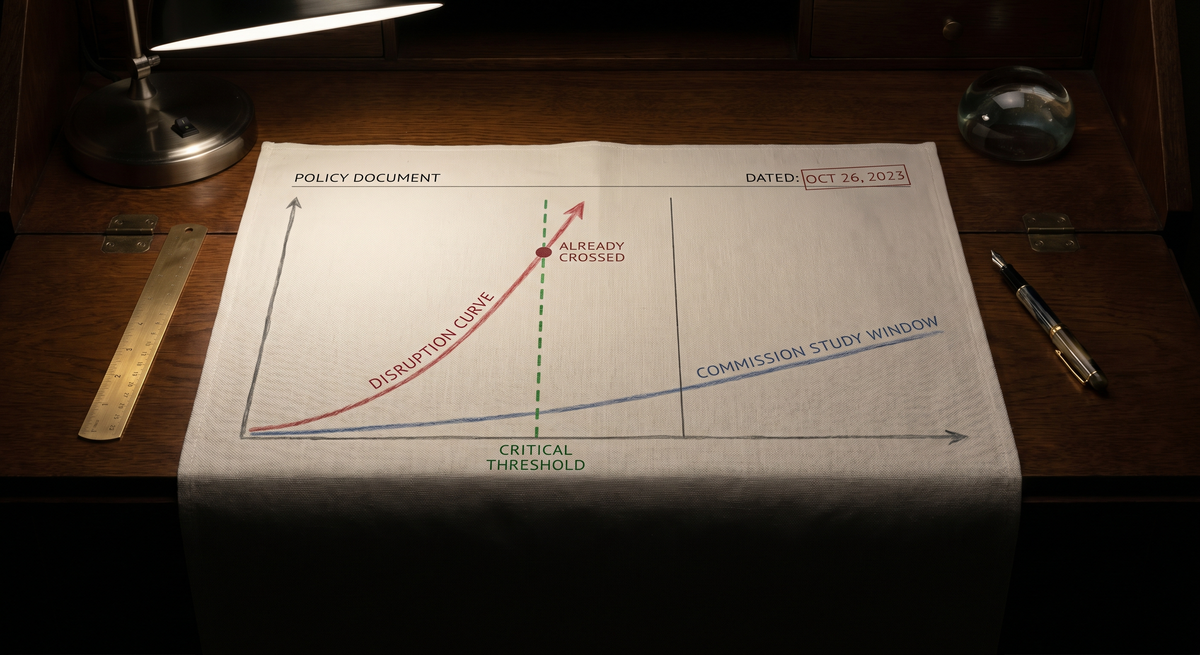
Seven months from April puts the interim report in November 2026. Thirteen months lands it in May 2027. By that point, the Goldman Sachs analysis of net AI labor displacement will be roughly a year old. The Department of Labor's worker-classification rulemaking — which closed its comment period on April 28 and is now proceeding to finalization — will have been settled without the commission's input. The three-dataset convergence on entry-level labor market stress that Yale, Anthropic, and Stanford HAI are documenting in young workers aged 22–25 will have had another year to compound. The Brookings Institution analysis of 15 million workers in gateway occupations — jobs that historically provided upward mobility pathways for workers without college degrees — will have aged into something closer to a reckoning than a projection.
Congress is proposing to study a condition that is already producing measurable outcomes in current data.
This is not unusual. The standard legislative model for responding to economic disruption is to appoint a commission to study the disruption, produce recommendations that may or may not inform legislation, which may or may not pass, on a timeline that may or may not fit the problem. The sequence for the 2008 financial crisis produced the Financial Crisis Inquiry Commission, which issued its final report in January 2011, two and a half years after Lehman Brothers collapsed. The Dodd-Frank Act, passed in 2010, predated the Commission's final recommendations.
The sequence for AI labor displacement is proceeding on similar logic, with the difference that the disruption is diffuse rather than acute. A financial crisis announces itself. An employment transformation accumulates in cohort data and household surveys and does not.
What the Commission Would Actually Do
The section-by-section summary released by Senator Warner's office describes a commission charged with evaluating workforce development systems, assessing projected AI impacts on jobs, and developing legislative recommendations on reskilling, tax policy, unemployment insurance, and long-term economic growth. It would also examine strategies to strengthen U.S. competitiveness in emerging technologies.
The last item is worth noting. A commission tasked with both protecting workers from AI displacement and strengthening U.S. AI competitiveness will be navigating a tension that Congress has not explicitly resolved. The policy responses to those two goals are not always compatible. Slowing the deployment of AI to protect labor market stability reduces competitive position relative to jurisdictions that don't. Accelerating deployment to maintain competitive position accelerates the labor market stress. The commission can study the tension. It cannot dissolve it.
The bill's bipartisan framing — Obernolte and Jacobs in the House, Warner and Rounds in the Senate — is the actual news value of the legislation. Agreement across party lines that Congress has a responsibility to respond to AI labor disruption represents a meaningful shift from the White House AI legislative framework released in March, which declined to address labor displacement or agent rights. A Republican and a Democrat introducing companion bills is the political signal. What the commission does with it, thirteen months from now, is the policy substance.
The Policy Instrument Gap
The commission model is a study instrument. It is not, by itself, a policy instrument. Its value depends entirely on what Congress does with its recommendations.
The existing policy response to AI labor displacement has consisted of, in approximate order: a non-binding White House AI legislative framework that declined to address workforce transition; a seven-day Department of Labor SMS course on AI literacy; and the DOL worker-classification rulemaking that, if finalized, makes it easier to classify AI-adjacent workers as independent contractors.
The Economy of the Future Commission Act adds: a study.
The scale mismatch between the policy response and the disruption being studied is not an argument against the study. Understanding the precise mechanism and magnitude of AI labor displacement is genuinely useful. The Atlanta Federal Reserve's April paper on corporate executive plans for workforce reduction found that executives at larger firms are already planning AI-driven headcount reductions that have not yet appeared in aggregate employment data. The Yale Budget Lab's tracking of CPS household survey data finds the aggregate unemployment rate stable while cohort divergence for workers aged 22–25 is accelerating. Independent measurement, conducted by a body without a financial stake in the findings, is what the field currently lacks.
The argument against the study is not that the study is worthless. It is that a thirteen-month timeline for final recommendations is what a cautious legislature produces when the disruption is not yet producing the kind of concentrated political pressure that accelerates legislation. The agricultural crisis of the 1980s — which bears comparison to the current farm credit and input cost crisis we covered last week — took nearly a decade to produce meaningful federal response, and the farmers bearing the concentrated costs were a defined constituency with existing political infrastructure. AI labor displacement is diffuse, affects workers across sectors and geographies, and the affected workers have no organized representative body making claims on Congress.
The Structural Question
The commission's mandate includes unemployment insurance reform. This is the provision worth watching.
The U.S. unemployment insurance system was designed around the assumption that job loss is episodic — that workers lose specific jobs and find new ones, with UI bridging the gap. The labor market disruption that Goldman Sachs, Yale, and the Atlanta Fed are documenting is not primarily episodic. It is compositional: a sustained shift in which occupations are created versus which are contracted, concentrated in specific cohorts, generating not unemployment in the traditional sense but wage compression, stalled mobility, and the erosion of the pathways that previously allowed workers to build toward better-compensated roles.
UI reform that addresses episodic displacement will not address compositional displacement. The commission will need to identify and recommend a policy instrument designed for the disruption that is actually occurring, not the disruption that existing policy tools were built for. That is a harder intellectual problem than the legislation acknowledges, and the thirteen-month timeline for final recommendations does not suggest Congress has fully appreciated it.
The Economy of the Future Commission Act is a step. Whether it produces anything more than a study — and whether Congress moves faster than the labor market absorbs the workers the study is designed to protect — depends on political dynamics that will become clearer, if history is any guide, after the disruption is already visible in aggregate data.
By then, the commission's interim report will be due in seven months.
Sources: Obernolte-Jacobs press release, April 21, 2026; Warner-Rounds Senate introduction, March 11, 2026; Section-by-section summary; MeriTalk coverage, April 22, 2026; Financial Crisis Inquiry Commission, GovInfo; White House AI Legislative Framework, March 2026; DOL worker-classification rulemaking, Feb 26, 2026.